Article
Why Sinus Infections Come Back After Sinus Surgery
Quick answer: Sinus surgery opens blocked sinuses so they drain and so rinses and sprays can reach the lining, but it does not cure the inflammation behind chronic sinusitis. Symptoms can come back because that inflammation flares up, a bacterial infection sets in, scar tissue or leftover blockage narrows the drainage pathways, or the problem is not coming from the sinuses at all (migraine is a common look-alike). An ENT can usually tell which with a quick camera exam in the office and, when needed, a CT scan. Most people never need a second operation: over 5 to 10 years, about 15% to 20% do.
Sinus surgery improves quality of life for most people with chronic sinusitis and cuts down on antibiotic use (Alanin and Hopkins, 2020). So it is discouraging when the pressure, congestion or thick drainage starts to come back. Returning symptoms do not always mean the surgery failed, and they do not always mean another infection. This article explains the common reasons, how we sort them out, and what can be done, whether your surgery was with us or somewhere else. If your surgery was for nasal polyps, see also our article on whether nasal polyps can come back.
Is It Normal for Sinus Problems to Come Back After Surgery?
It is common for some symptoms to return, especially in the years after surgery. Chronic sinusitis is long-term inflammation of the lining of the sinuses. Endoscopic sinus surgery widens the natural drainage pathways and removes blocked tissue, but it does not switch off the inflammation underneath, so ongoing care still matters (Hopkins, 2019).
How often people need a second operation (revision surgery) depends on how long they are followed:
- In a California study of more than 61,000 people, about 7 in 100 had a second operation during the years the study covered (Stein et al., 2018).
- Over 5 to 10 years, the best estimate is about 15% to 20% (Alanin and Hopkins, 2020).
- Among people with nasal polyps, about 19% have a second operation. The rate is higher with aspirin-exacerbated respiratory disease (27%), allergic fungal sinusitis (29%) or asthma (23%) (Loftus et al., 2020).
Symptoms coming back do not automatically mean another operation. Most are treated with medicine first.
Is It a New Infection or the Underlying Inflammation?
For most people with chronic sinusitis, the main problem is ongoing swelling of the sinus lining, with bacterial infections appearing now and then on top of it (Payne et al., 2025). The difference matters, because antibiotics treat a bacterial infection but do nothing for the inflammation.
Signs that point toward a bacterial sinus infection:
- Thick, discolored drainage together with a blocked nose or facial pain or pressure
- Symptoms that last 10 days or more without getting better, or that start to improve and then get worse again (Payne et al., 2025)
Signs that point toward inflammation flaring up:
- Congestion, pressure or a weaker sense of smell that creeps back over weeks or months, without a cold-like start
- Swelling or polyps that we can see on an exam, without pus
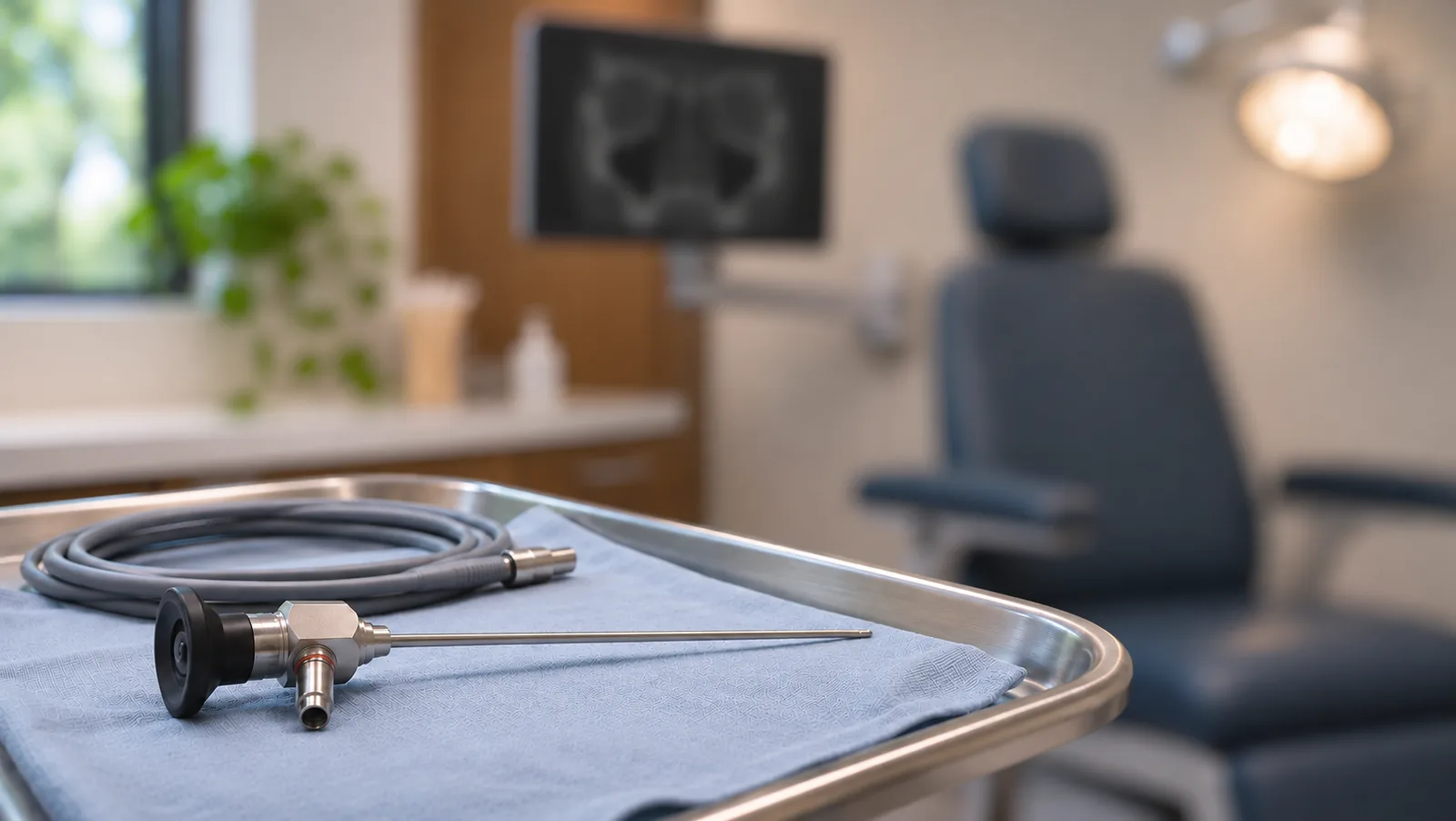
After surgery, we can often settle the question by looking. Because the sinuses are now open, a thin camera (a nasal endoscope) used in the office lets us see right into them. If there is pus, we can take a sample from the sinus itself, which shows which bacteria are there and which antibiotic will work (Miller et al., 2024).
Why Do Sinus Symptoms Come Back?
Often more than one of these is at work.
The inflammation is still active. Some forms of chronic sinusitis are more stubborn than others. Nasal polyps are the clearest example, especially with asthma, with aspirin-exacerbated respiratory disease (asthma, nasal polyps and breathing reactions to aspirin or similar pain relievers) or with allergic fungal sinusitis (an allergic reaction to fungus in the sinuses) (Loftus et al., 2020).
Something is still narrowing the drainage pathways. In a study of people having a second operation, the most common findings were the middle turbinate (a curled shelf of bone and tissue on the side wall of the nose) drifting sideways toward the sinus openings, sinus cells that had not been fully opened, scar tissue, and narrowing of the opening into the cheek (maxillary) sinus (Musy and Kountakis, 2004). The forehead (frontal) sinus has the narrowest, most winding drainage path and is the sinus most likely to block again. In one study of frontal sinuses that needed a second operation, most had more than one cause, with swollen lining (67%) and leftover ethmoid cells (53%) the most common (Otto and DelGaudio, 2010).
Another condition is adding to it. Allergies, low levels of infection-fighting antibodies, cystic fibrosis and primary ciliary dyskinesia (a condition in which the tiny hairs that sweep mucus out of the sinuses do not work properly) all make sinus disease harder to control (Payne et al., 2025). In one review, about 13% of people whose chronic sinusitis kept coming back, and 23% of those whose sinusitis stayed uncontrolled despite surgery, had low antibody levels (Schwitzguébel et al., 2015).
Daily care has slipped. Open sinuses let saline rinses and steroid sprays reach the lining much better than before surgery (Hopkins, 2019). After polyp surgery, a daily steroid spray lowers the chance of polyps returning (Fandíño et al., 2013). When rinses and sprays stop, inflammation can build back up.
Could It Be Something Other Than My Sinuses?
Yes, and it is more common than many people expect. Facial pressure and headache are often blamed on the sinuses when the cause is somewhere else. In a study of nearly 3,000 people who had a "sinus headache" (diagnosed by a doctor or by themselves), 88% actually had migraine-type headaches. Many of them felt sinus pressure, sinus pain and a stuffy nose during their headaches (Schreiber et al., 2004). Other look-alikes include tension headaches, jaw joint (TMJ) pain and nerve pain in the face (Jayawardena and Chandra, 2018).
One clue: if your main symptom is pressure or headache, and your nose is not very blocked and you do not have thick, discolored drainage, the cause may not be your sinuses. A normal camera exam or CT scan helps rule sinus disease in or out, which avoids antibiotics that will not help and points to the treatment that will (Jayawardena and Chandra, 2018). If migraine turns out to be the cause, our guide to managing migraine is a good place to start.
How Do We Find Out What Is Causing It?
A follow-up visit usually includes:
- A camera exam (nasal endoscopy). It takes a few minutes in the office and shows whether the sinus openings are clear, swollen, scarred or blocked by polyps, and whether there is pus.
- A sample (culture) from the sinus if there is pus, so any antibiotic is matched to the bacteria.
- A CT scan when the exam does not explain your symptoms, or when a second operation is being considered. It shows areas the camera cannot reach, especially the drainage path of the forehead sinus. Our Austin, Lakeway and Dripping Springs offices have a low-dose CT scanner, so the scan can often be done at the same visit.
- Allergy testing or blood tests of immune function when your history suggests them (Payne et al., 2025).
What Can Be Done When Symptoms Come Back?
Treatment depends on the cause:
- Back to the daily basics. Saline rinses with distilled, sterile, or boiled and cooled water, plus a steroid spray or a steroid rinse if your ENT recommends one.
- Antibiotics only for a bacterial infection, chosen from a culture when possible.
- A course of steroid pills for flare-ups of nasal polyps.
- Biologic medicines for nasal polyps that keep coming back. We prescribe and manage all four biologics approved for nasal polyps: Dupixent (dupilumab), Xolair (omalizumab), Nucala (mepolizumab) and Tezspire (tezepelumab). See biologics for nasal polyps.
- A second operation when there is something surgery can fix, such as a drifted turbinate, scar tissue, sinus cells that are still blocked, or polyps that keep medicine from reaching the sinuses (Shin et al., 2025).
A second operation can still help a great deal. In a study comparing people having their first and second sinus surgery, both groups improved, and they were equally likely to see their quality of life improve (Litvack et al., 2007). A later study across three centers found first-time patients somewhat more likely to improve (Smith et al., 2010), so we talk through what a second surgery can and cannot be expected to do.
When Should I Call an ENT?
Make an appointment if:
- Sinus symptoms last more than 10 days or keep coming back
- You keep needing antibiotics for sinus infections
- Your sense of smell is fading again
- Your symptoms are creeping back and it has been a while since your last checkup after surgery
Get care right away (call us, or go to the emergency room after hours) for:
- Swelling or redness around the eye, a bulging eye, double vision or any change in vision
- Swelling of the forehead
- A severe headache, a stiff neck, confusion or a high fever
Sources
- Alanin MC, Hopkins C. Effect of Functional Endoscopic Sinus Surgery on Outcomes in Chronic Rhinosinusitis. Current Allergy and Asthma Reports. 2020;20(7):27. doi:10.1007/s11882-020-00932-6. PubMed
- Stein NR, Jafari A, DeConde AS. Revision rates and time to revision following endoscopic sinus surgery: A large database analysis. The Laryngoscope. 2018;128(1):31-36. doi:10.1002/lary.26741. PubMed
- Loftus CA, Soler ZM, Koochakzadeh S, et al. Revision surgery rates in chronic rhinosinusitis with nasal polyps: meta-analysis of risk factors. International Forum of Allergy & Rhinology. 2020;10(2):199-207. doi:10.1002/alr.22487. PubMed
- Hopkins C. Chronic Rhinosinusitis with Nasal Polyps. New England Journal of Medicine. 2019;381(1):55-63. doi:10.1056/NEJMcp1800215. PubMed
- Payne SC, McKenna M, Buckley J, et al. Clinical Practice Guideline: Adult Sinusitis Update. Otolaryngology-Head and Neck Surgery. 2025;173(Suppl 1):S1-S56. doi:10.1002/ohn.1344. PubMed
- Miller JM, Binnicker MJ, Campbell S, et al. Guide to Utilization of the Microbiology Laboratory for Diagnosis of Infectious Diseases: 2024 Update by the Infectious Diseases Society of America (IDSA) and the American Society for Microbiology (ASM). Clinical Infectious Diseases. 2024. doi:10.1093/cid/ciae104. PubMed
- Musy PY, Kountakis SE. Anatomic findings in patients undergoing revision endoscopic sinus surgery. American Journal of Otolaryngology. 2004;25(6):418-422. doi:10.1016/j.amjoto.2004.06.002. PubMed
- Otto KJ, DelGaudio JM. Operative findings in the frontal recess at time of revision surgery. American Journal of Otolaryngology. 2010;31(3):175-180. doi:10.1016/j.amjoto.2008.12.006. PubMed
- Schwitzguébel AJ, Jandus P, Lacroix JS, Seebach JD, Harr T. Immunoglobulin deficiency in patients with chronic rhinosinusitis: Systematic review of the literature and meta-analysis. Journal of Allergy and Clinical Immunology. 2015;136(6):1523-1531. doi:10.1016/j.jaci.2015.07.016. PubMed
- Fandíño M, Macdonald KI, Lee J, Witterick IJ. The use of postoperative topical corticosteroids in chronic rhinosinusitis with nasal polyps: a systematic review and meta-analysis. American Journal of Rhinology & Allergy. 2013;27(5):e146-e157. doi:10.2500/ajra.2013.27.3950. PubMed
- Schreiber CP, Hutchinson S, Webster CJ, et al. Prevalence of migraine in patients with a history of self-reported or physician-diagnosed "sinus" headache. Archives of Internal Medicine. 2004;164(16):1769-1772. doi:10.1001/archinte.164.16.1769. PubMed
- Jayawardena ADL, Chandra R. Headaches and facial pain in rhinology. American Journal of Rhinology & Allergy. 2018;32(1):12-15. doi:10.2500/ajra.2018.32.4501. PubMed
- Shin JJ, Wilson M, McKenna M, et al. Clinical Practice Guideline: Surgical Management of Chronic Rhinosinusitis. Otolaryngology-Head and Neck Surgery. 2025;172(Suppl 2):S1-S47. doi:10.1002/ohn.1287. PubMed
- Litvack JR, Griest S, James KE, Smith TL. Endoscopic and quality-of-life outcomes after revision endoscopic sinus surgery. The Laryngoscope. 2007;117(12):2233-2238. doi:10.1097/MLG.0b013e31814539e8. PubMed
- Smith TL, Litvack JR, Hwang PH, et al. Determinants of outcomes of sinus surgery: a multi-institutional prospective cohort study. Otolaryngology-Head and Neck Surgery. 2010;142(1):55-63. doi:10.1016/j.otohns.2009.10.009. PubMed
This article is for educational purposes only and does not replace an in-person evaluation.