
Inspire Therapy
for Sleep Apnea in Austin, TX
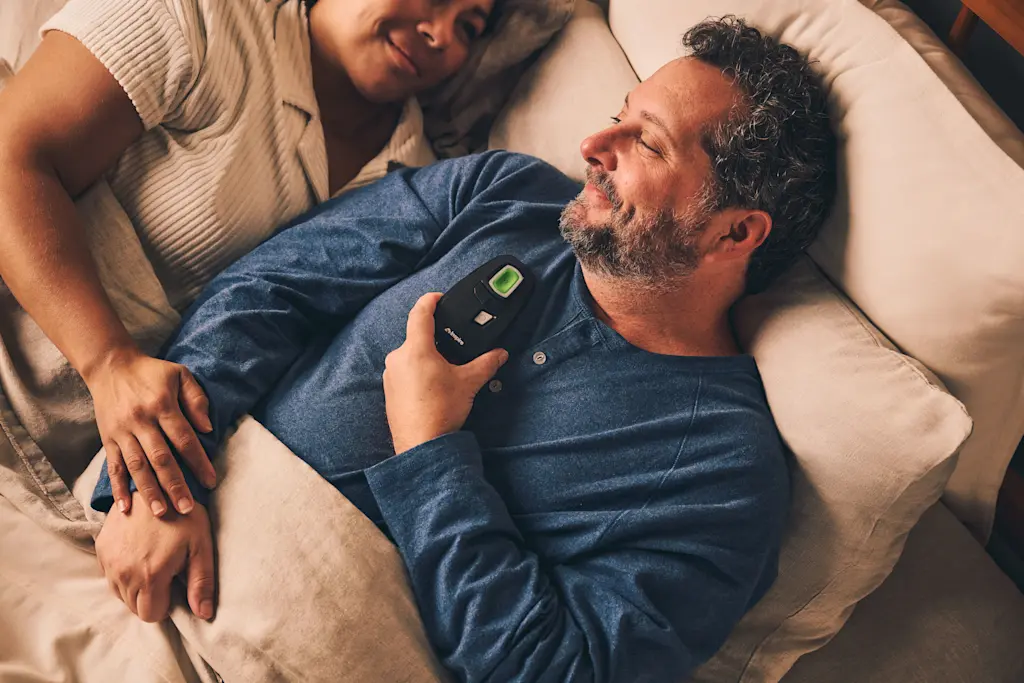
Sleep apnea treatment without a mask, hose, or machine. Inspire is an FDA-approved implant that keeps your airway open while you sleep, activated by a simple remote control at bedtime. Capital ENT evaluates and treats Inspire candidates across Central Texas.
What Is Inspire Therapy?
Inspire is an FDA-approved implantable neurostimulator that treats moderate-to-severe obstructive sleep apnea (OSA) by stimulating the hypoglossal nerve to keep the airway open during sleep. The device is placed under the skin of the upper chest during a short outpatient procedure under general anesthesia. Unlike CPAP, there is no mask, no hose, and no machine; patients turn it on with a small remote at bedtime. The device monitors your breathing and delivers mild stimulation that gently moves the tongue and airway muscles forward while you sleep.
Inspire is specifically designed for patients who cannot tolerate or do not benefit from CPAP therapy. You simply press a button on a small remote control at bedtime to turn it on and press again in the morning to turn it off. Capital ENT provides Inspire evaluation, surgery, activation, and follow-up for patients across Central Texas. It is one of several sleep apnea treatment options we offer.
- FDA-approved for moderate-to-severe obstructive sleep apnea
- No mask, no hose, no machine. Just a small remote at bedtime
- Implanted during a short outpatient procedure
- Evaluation, surgery, activation, and long-term follow-up in one sleep program
- Central Texas care team experienced with Inspire candidacy and optimization
- Most major insurance plans accepted, including Medicare
*Average AHI from Capital ENT patients’ sleep studies before implant and after implant. Individual results vary.
Who Benefits from Inspire Therapy?
Inspire is designed for a specific group of sleep apnea patients. Here is how to know if you may qualify.
Good Candidates
You may be a great fit for Inspire if you have:
- Moderate-to-severe obstructive sleep apnea (AHI 15-100)
- Cannot tolerate or do not benefit from CPAP therapy
- BMI up to 40, with insurance criteria sometimes stricter
- 18 or older
- No complete concentric collapse at the palate (confirmed by DISE)
May Need a Different Approach
Inspire may not be the best fit if you have:
- Mild sleep apnea (AHI under 15)
- BMI over 40
- Central sleep apnea (not obstructive)
- Complete concentric palatal collapse on DISE
The best way to find out if you are a candidate is a consultation with one of our sleep specialists. We will review your sleep study and evaluate your airway to recommend the right treatment for you.
Inspire vs. CPAP
See how Inspire therapy compares to traditional CPAP treatment for obstructive sleep apnea.
| Inspire | CPAP | |
|---|---|---|
| Mask Required | No mask | Mask required nightly |
| Noise Level | Silent | Audible machine noise |
| Portability | Nothing to carry (implanted) | Machine, hose, mask to transport |
| Compliance | High, simple remote at bedtime | Many patients struggle with adherence |
| Maintenance | No cleaning or supplies needed | Regular cleaning, filter and mask replacement |
| Setup | Outpatient surgery required | No surgery, prescription device |
| Best For | CPAP-intolerant patients with moderate-to-severe OSA | Patients who tolerate mask therapy well |
Not sure which treatment is right for you? Our sleep specialists will evaluate your condition and recommend the best approach during your consultation. See the full CPAP vs Inspire comparison →
What Untreated Sleep Apnea Does to Your Body
Sleep apnea is not just snoring or daytime fatigue. When left untreated, moderate-to-severe obstructive sleep apnea creates a cycle of repeated oxygen deprivation that stresses the heart, brain, and metabolic system in ways that accumulate over years. This is why our specialists treat moderate-to-severe OSA as a medical condition requiring consistent management, not a lifestyle nuisance to ignore.
Cardiovascular Risk
Untreated moderate-to-severe OSA is independently associated with high blood pressure, atrial fibrillation, heart failure, and elevated stroke risk. Each apnea event triggers a surge of sympathetic nervous system activity that stresses the heart throughout the night.
Metabolic Consequences
Fragmented sleep impairs insulin sensitivity and is linked to higher rates of type 2 diabetes and metabolic syndrome. Effective OSA treatment has been shown to support better blood sugar regulation in many patients and improve metabolic markers over time.
Daytime Function
Excessive daytime sleepiness from OSA significantly increases the risk of motor vehicle accidents. Cognitive effects including memory impairment, slowed reaction time, and difficulty concentrating accumulate over years of untreated disease and often go unrecognized as sleep-related.
Sleep Architecture
Most patients with untreated moderate-to-severe OSA never reach the deep, restorative sleep stages the body requires. No amount of extra time in bed compensates for sleep that is constantly interrupted. Restoring continuous sleep changes how patients feel, function, and age.
Going Untreated Is Not a Neutral Choice
An estimated 82% of men and 93% of women with moderate-to-severe sleep apnea have never been diagnosed. Among those who are diagnosed and prescribed CPAP, long-term adherence rates are low: studies report that 46% to 83% of patients use CPAP less than 4 hours a night, below the threshold for effective therapy.
For these patients, Inspire offers a path to consistent, effective treatment without nightly mask compliance. For patients who cannot use CPAP and who qualify, Inspire is one of the medically appropriate next steps.
Sleep Apnea in Central Texas
Central Texas presents specific challenges for sleep apnea patients. The region's intense cedar, oak, and mountain cedar allergy season runs nearly year-round, causing nasal congestion that worsens upper airway obstruction and makes CPAP tolerance even harder. Many patients find that CPAP compliance drops sharply during peak allergy months.
Austin's population also skews younger and more active than the national average, which can delay diagnosis. Active, otherwise healthy adults often attribute daytime fatigue to work stress rather than a sleep disorder. Capital ENT has provided Inspire therapy to hundreds of patients across Austin, Lakeway, Marble Falls, and Dripping Springs, many of whom came to us after years of inadequate CPAP compliance.
How to Get Inspire Therapy
From initial evaluation to long-term results: here is what to expect on the path to better sleep.
-
Consultation & Sleep Study
Your ENT evaluates your sleep apnea severity and CPAP history. A sleep study confirms moderate-to-severe obstructive sleep apnea and helps determine if Inspire may be right for you.
-
DISE Evaluation
Drug-Induced Sleep Endoscopy is a brief sedated procedure that allows your surgeon to view exactly where your airway collapses during sleep and confirm that you are a good candidate for Inspire.
-
Implant Procedure
A short outpatient surgery, typically 60–90 minutes, to place the Inspire device. Two small incisions are made to position the pulse generator and stimulation lead. Most patients go home the same day.
-
Activation & Optimization
The device is activated approximately one month after surgery. Settings are fine-tuned over follow-up visits using your sleep data to ensure optimal therapy and maximum benefit.
Your Inspire Procedure Day at Capital ENT
The Inspire implant is performed as a same-day outpatient procedure, typically at a surgery center where our ENTs hold operating privileges. Here is a clear picture of what the day looks like and what the first month of recovery involves.
Before Surgery
Our clinical team provides specific preparation instructions after your procedure is scheduled. Plan to have nothing to eat or drink after midnight the night before. Arrange for a driver, as general anesthesia requires you not to operate a vehicle afterward. Wear comfortable, loose-fitting clothing that opens at the front since your surgeon will be working near the right collarbone.
During the Procedure
The operation takes approximately 60 to 90 minutes under general anesthesia. Our surgeon makes two small incisions: one just below the right collarbone, where the pulse generator is placed under the skin, and one under the right side of the jaw, where the stimulation lead is positioned near the hypoglossal nerve. Depending on the device generation, older Inspire systems also used a separate breathing-sensor lead; the newest system (Inspire V) does not. The incisions are each a few centimeters long and closed with dissolvable sutures.
Recovery Room and Discharge
After surgery you spend 1 to 2 hours in the post-anesthesia care unit as anesthesia wears off. Pain is typically mild to moderate and well-managed with over-the-counter acetaminophen combined with ibuprofen or naproxen. Most patients are discharged the same afternoon and feel comfortable enough to return to desk work within 2 to 4 days. Heavy lifting, strenuous activity, and swimming should be avoided for the first week.
The First Month: Healing Before Activation
The device is intentionally not activated on surgery day. The 4-week healing period allows the stimulation lead to integrate with surrounding tissue, which stabilizes the lead position and helps ensure accurate therapy delivery during your first activation visit. Activating too early can lead to suboptimal initial settings.
During this healing period, most patients experience mild soreness that resolves within 1 to 2 weeks. You should avoid:
- Heavy lifting or strenuous activity for the first week
- Reaching overhead, or lifting more than very light weight with the arm on your implant side (usually the right), for 2 weeks; this protects the chest incision
- Swimming or submerging the incisions in water for the first week
Activation and Optimization
At your 4-week activation appointment in our office, our team programs the device at a conservative starting level and trains you on the handheld remote. You begin using Inspire every night from this point. Over 2 to 3 follow-up visits spanning the next 2 to 3 months, the therapy level is gradually adjusted based on your response and sleep data downloaded from the device. Most patients reach optimal settings within 3 months of activation.
One advantage of Inspire over surgery that modifies anatomy: settings can always be adjusted. If your sleep changes over time, such as with weight change or aging, the therapy level can be recalibrated at a follow-up visit without additional procedures.
What to Expect After Inspire Surgery
A clear timeline so you know exactly what to expect from surgery day through long-term use.
Outpatient Procedure & Rest
The implant procedure typically takes 60–90 minutes under general anesthesia. You go home the same day. Plan to rest and avoid strenuous activity. Some soreness at the incision sites is normal.
Initial Healing
Mild soreness at the incision sites gradually improves. Most patients return to desk work and light daily activities within a few days. Avoid heavy lifting and vigorous exercise during this period.
Device Activation
You return to the office for your activation appointment. Your provider turns on the Inspire device and configures the initial therapy settings. You begin using the device nightly with your handheld remote.
Optimization
Follow-up visits allow your provider to review your sleep data and fine-tune the therapy settings. Most patients notice significant improvement in sleep quality and daytime energy during this period.
Nightly Use & Annual Follow-Ups
Simply use your remote to turn Inspire on at bedtime and off in the morning. Annual follow-up appointments ensure your therapy remains optimized. The battery lasts approximately 10 years.
Living With Your Inspire Device
Inspire is designed to fit into normal life. Here is what patients most often ask about day-to-day experience with the implant.
Your Nightly Routine
Before bed, press the button on your Inspire remote to activate the device. A programmable start delay allows you to fall asleep before stimulation begins. Press the remote in the morning to turn it off. The entire routine takes seconds. Most patients find it second nature within the first week, and many report that the simplicity compared to nightly CPAP setup is itself a quality-of-life improvement.
Travel and Airport Security
The Inspire pulse generator contains metal components and will trigger airport security screening equipment, including walk-through metal detectors. Inspire provides a medical device identification card to carry when flying. Full-body millimeter-wave scanners used at most TSA checkpoints are compatible with the device. Turn your therapy off and inform security officers of your implant before entering any scanner. Our team reviews travel considerations at every activation appointment.
Physical Activity
Once your incisions have healed, Inspire itself places no ongoing limits on exercise or travel; many patients run, swim, cycle, lift weights, and travel as usual. The pulse generator sits below the skin of the upper chest and does not interfere with upper body movement once healing is complete. Many patients report that their capacity for activity improves substantially once they are sleeping well.
Medical and Dental Procedures
Before any procedure involving electrosurgery, diathermy, or certain medical imaging, inform the provider that you have an Inspire implant. Current-generation Inspire IV and V systems are approved for full-body 1.5T MRI and, under specific conditions, 3.0T MRI, following the manufacturer's safe-scan guidelines. Tell your dentist about your implant too; some dental and medical equipment calls for the device to be turned off during use. Our team can provide your device specifications for any treating provider who needs documentation.
Sleep Position
Inspire therapy works in any sleep position: back, side, or stomach. You are not restricted to a particular position the way patients using positional therapy devices are. Most patients report that sleep comfort improves progressively over the first 2 to 3 months as therapy settings are gradually optimized to their anatomy. Bed partners typically notice the change first: the snoring stops.
Battery and Long-Term Device Management
The Inspire pulse generator battery lasts approximately 10 years under typical nightly use. When the battery reaches end of life, it is replaced through a brief outpatient procedure using the same incision as the original implant. The stimulation lead (and, on older systems, the breathing-sensor lead) does not need to be replaced. Patients typically transition from one generator to the next with minimal disruption. Annual follow-up visits allow us to monitor battery life and download therapy data so there are no surprises.
Capital ENT Patient Outcomes
Our Inspire patients experience dramatic improvement in sleep apnea severity, measured by the Apnea-Hypopnea Index (AHI).
Based on average AHI scores from Capital ENT Inspire patients. Individual results may vary.
Hear From Our Inspire Patients
Watch how Inspire therapy has transformed the lives of our patients: better sleep, more energy, and freedom from CPAP.
Long-Term Outcomes: What the Research Shows
Inspire is the most extensively studied upper airway stimulation therapy for obstructive sleep apnea, with over a decade of published clinical data from both controlled trials and large real-world registries.
The STAR Trial
The pivotal Inspire clinical trial, the STAR trial published in the New England Journal of Medicine (Strollo et al., 2014), enrolled 126 adults with moderate-to-severe OSA who had failed CPAP therapy. At 12 months:
- 66% of participants met the pre-specified surgical success criterion (at least 50% AHI reduction with post-treatment AHI below 20 events per hour)
- Snoring improved substantially: in 3-year follow-up, the share of bed partners reporting soft or no snoring rose from 17% at baseline to 80%
- Daytime sleepiness (Epworth Sleepiness Scale) improved significantly, with patients moving from pathological to normal ranges
- Functional outcomes, measured by the Functional Outcomes of Sleep Questionnaire, improved across all domains including work performance and activity level
Long-Term Durability
Long-term follow-up of STAR trial participants and patients in subsequent open-label extension studies has confirmed that Inspire results are durable. At 5 years, 75% of participants who completed a follow-up sleep study still met the response criteria (Woodson et al., 2018), and benefits in sleepiness and quality of life were largely maintained for patients who continued nightly therapy.
The ADHERE registry, which tracks real-world Inspire outcomes across implanting centers in the United States and Europe, has published data consistently showing results comparable to the pivotal trial across a broader patient population. The registry's findings reflect the benefit of systematic pre-operative DISE evaluation: careful screening identifies the patients most likely to respond well.
Capital ENT Outcomes
At Capital ENT, Inspire outcomes are tracked with sleep-study results, symptom response, and follow-up visits after activation. Careful patient selection, consistent pre-operative DISE evaluation, and close post-activation follow-up help our team optimize therapy settings over the months following implantation.
Inspire is not guaranteed to achieve surgical success in every patient. During your consultation, our team will give you a realistic expectation based on your anatomy, OSA severity, BMI, and DISE findings.
Insurance & Cost Information
Inspire therapy is a significant investment in your quality of life, and most patients find it well-covered by insurance. Our team handles the authorization process so you can focus on feeling better.
- Most major insurance plans accepted, including Medicare
- Prior authorization managed by our team before surgery is scheduled
- Documented sleep apnea diagnosis and failed CPAP trial typically required for coverage
- HSA and FSA accounts accepted
Find Out If You Qualify
Schedule a consultation to determine if Inspire is right for you. Our team will verify your insurance benefits and walk you through the process.
Schedule a ConsultationInspire Therapy FAQ
Related Patient Guides
What Is Sleep Apnea?
Symptoms, risk factors, and why treatment matters for your health.
All About Sleep Apnea
A guide to diagnosis, treatment options, and outcomes.
Are Oral Appliances Effective for Sleep Apnea?
Comparing treatment alternatives to CPAP therapy.
How Can I Stop Snoring?
From lifestyle changes to medical treatments for persistent snoring.
Inspire vs. UPPP Surgery
Comparing two surgical options for obstructive sleep apnea: implant vs. palate surgery.
More Sleep Health Resources
Snoring Treatment
Snoring and sleep apnea are closely linked. Our ENT specialists evaluate the anatomical causes of snoring and offer minimally invasive in-office treatments.
GLP-1 Therapy & Sleep Apnea
Weight loss through GLP-1 medication can significantly reduce OSA severity. We offer in-office GLP-1 therapy integrated with your sleep care at Capital ENT.
Mouth Taping & Nasal Breathing
Mouth taping is not safe for patients with untreated sleep apnea. If you're curious, get an evaluation first to rule out OSA before trying any nighttime airway interventions.
Do Oral Appliances Work?
For patients who don't need Inspire, a custom oral appliance, made by a dental sleep specialist we refer you to, can be an option, and usually works best for mild to moderate sleep apnea. Learn how well they work and who qualifies.
Find Out If You Are a Candidate for Inspire
Schedule a consultation. We will review your sleep study and your CPAP history and explain the steps to qualify.