Article
Nosebleeds in Children: When to Worry
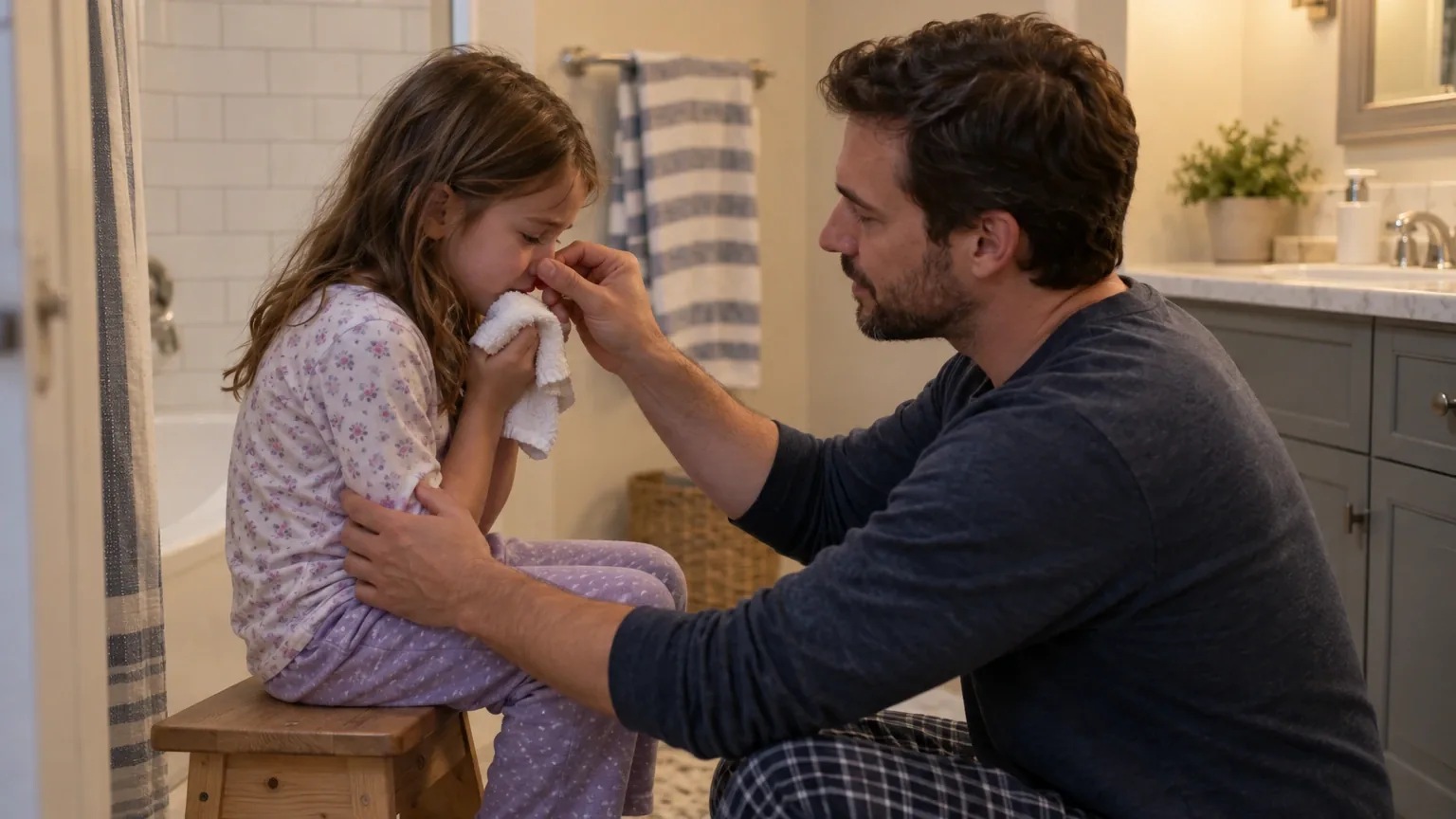
Quick answer: Most nosebleeds in children start from small blood vessels at the front of the nose, are set off by dry air, colds, allergies or nose picking, and stop with 10 to 15 minutes of steady pressure. See an ENT specialist if your child has nosebleeds more than once a week, nosebleeds that are hard to stop, easy bruising, a family history of bleeding problems, or bleeding or blockage on one side only. Go to the emergency room for heavy bleeding, bleeding that continues after two rounds of pressure, or a nosebleed with fainting or trouble breathing.
A child's nosebleed can look like a lot of blood, and it often happens at night. Most are harmless and stop with simple pressure. This article covers why children get nosebleeds, which signs deserve a closer look, and what we can do when they keep coming back. For first aid in more detail, see our article on how to stop a nosebleed and our printable nosebleed first aid guide.
How Common Are Nosebleeds in Children?
Very common. More than half of children have had a nosebleed by age 10, and about 9 in 100 have them again and again. They are uncommon before age 2, so a nosebleed in a baby or toddler under 2 is worth a call to your child's doctor.
Why Do Children Get Nosebleeds?
About 9 in 10 nosebleeds in children start at the front of the septum (the wall between the two sides of the nose), where several small blood vessels sit close to the surface. Anything that dries or irritates that spot can start a bleed:
- Dry air: Heated indoor air in winter and air conditioning in summer dry out the lining of the nose.
- Nose picking and rubbing: In one study of children with nosebleeds and nasal allergies, 9 in 10 picked or rubbed their noses.
- Colds and allergies: Swelling, sneezing, itching and nose blowing all irritate the lining. In that same study, nosebleeds improved when the allergies were treated.
- Crusting inside the nostril: Crusts itch, children pick at them, and the same spot bleeds again.
- Steroid nasal sprays: These allergy sprays slightly raise the chance of a nosebleed. Aiming the spray away from the septum helps, and our steroid nasal spray guide shows how.
How Do I Stop My Child's Nosebleed?
Have your child sit up and lean forward. Pinch the whole soft part of the nose, below the hard, bony bridge, and hold steady pressure for 10 to 15 minutes by the clock without letting go to check. If it is still bleeding, do it once more. Do not tilt the head back, and do not stuff cotton or tissue into the nose.
A decongestant spray such as oxymetazoline (Afrin) can help the bleeding stop. For a child 6 or older, have your child gently blow out any clots, then give 2 sprays into the bleeding nostril before you pinch. Keep both your child and the bottle upright, because a bottle held upside down sprays far more. The spray is approved for ages 6 and up, so for a younger child use pressure alone unless your child's doctor has told you to use it. Store the bottle where young children cannot reach it.
When Is a Child's Nosebleed an Emergency?
Call us or go to the emergency room if the nose is still bleeding after two rounds of 10 to 15 minutes of steady pressure. Call 911 or go to the emergency room if your child:
- Has heavy bleeding that will not stop
- Has trouble breathing, or is lightheaded, pale or faint
- Has a nosebleed after a hard blow to the head or face
- May have put a button battery in the nose. A button battery can damage the septum, so do not wait to see whether symptoms develop.
Which Signs Suggest Something More Than a Dry Nose?
A few patterns deserve a visit even when each nosebleed stops easily:
- Signs of a bleeding disorder: These include easy bruising, very heavy periods in a teenager, and long bleeding after dental work, surgery or an injury, as well as relatives with bleeding problems. Studies suggest that 5% to 10% of children with repeated nosebleeds may have mild von Willebrand disease, an inherited condition in which blood clots more slowly, that has not yet been diagnosed.
- One side only, with a blocked nostril, in a teenage boy: This can be a sign of juvenile angiofibroma, an uncommon, noncancerous growth at the back of the nose found almost only in adolescent boys and young men.
- One side only, with foul-smelling drainage: Young children sometimes put small objects in the nose, and bad-smelling drainage from one nostril is the usual clue.
- Small red spots on the lips, tongue or fingertips, or frequent nosebleeds in a parent: These can point to hereditary hemorrhagic telangiectasia (HHT), an inherited blood vessel condition that affects about 1 in 5,000 people.
- A nosebleed before age 2.
Most children with nosebleeds have none of these.
When Should My Child See an ENT Specialist?
There is no agreed number of nosebleeds that counts as too many. We suggest a visit if your child:
- Has nosebleeds more than once a week
- Has nosebleeds that are hard to stop at home, or has needed an emergency room visit for one
- Keeps bleeding from the same side
- Has any of the signs in the section above
- Is missing sleep, school or activities because of nosebleeds
At the visit we ask about bruising, other bleeding and family history, and we look inside the front of the nose, where we can usually see the irritated blood vessel. Our pediatric ENT page describes how we care for children.
Does My Child Need Blood Tests?
Usually not. Blood tests are not needed for every child with nosebleeds. They make sense when nosebleeds do not improve with treatment, or when your child's history or family history suggests a bleeding disorder. Testing usually includes a blood count, clotting tests and specific tests for von Willebrand disease, and sometimes a visit with a hematologist (a blood specialist).
How Are Frequent Nosebleeds Treated?
Treatment starts with simple steps and adds more only if they are needed:
- Moisture: Saline gel or spray inside the nostrils and a humidifier by the bed. This is the usual first step, although it has not been well studied in children.
- Ointment: An antiseptic or antibiotic ointment placed just inside the nostrils for a few weeks, to calm crusting and irritation.
- Allergy treatment: When allergies are driving the itching, rubbing and picking.
- Cautery: Sealing the blood vessel in the office, described below.
The research in children is limited. A Cochrane review found only five small trials, and by the end of follow-up no treatment had clearly beaten another. A later analysis of four studies found that adding cautery to an antiseptic cream did not improve results over the cream alone. In a 2026 trial of 136 children, cautery worked fastest at 2 weeks, while a cream that combined an antiseptic and a steroid held up best at 6 months. Results vary from child to child, and study numbers cannot predict your own child's result.
What Is Nasal Cautery Like for a Child?
Cautery (also called cauterization) seals the blood vessel that keeps bleeding. We numb the front of the nose, then touch the vessel for a few seconds with silver nitrate, a chemical on the tip of a small stick. Many children can have this done awake in the office. It can sting for a moment.
Afterward, for at least 1 week, your child should avoid nose blowing, strenuous activity and heavy lifting, and should not put cotton or tissue in the nose. Use saline gel or spray 1 to 3 times a day to keep the area moist. Silver nitrate can leave a gray or black stain on skin it touches. The stain is harmless and fades. Crusting and infection are possible, and a hole in the septum is rare.
Will My Child Outgrow Nosebleeds?
Most children have fewer nosebleeds as they get older, although no study has followed untreated children long enough to say exactly when. Nosebleeds can also come back after treatment. In a study that checked on 145 children about 4 years after treatment, about half had had nosebleeds again, and most of those families (65%) had not needed further medical care for them.
How Can I Help Prevent Nosebleeds?
A moist nose bleeds less. These steps rest more on clinical experience than on trials in children, but they are simple and safe to try:
- Use saline spray during the day, and put a saline nasal gel just inside each nostril every morning and evening.
- Run a humidifier by your child's bed at night, especially in dry weather.
- Keep fingernails short, and discourage picking and rubbing.
- Treat allergies, and aim any steroid nasal spray away from the septum.
- Ibuprofen (Motrin, Advil) can make bleeding more likely. Acetaminophen (Tylenol) does not.
Our nosebleed first aid guide has the full prevention steps.
Sources
- Tunkel DE, Anne S, Payne SC, et al. Clinical Practice Guideline: Nosebleed (Epistaxis). Otolaryngology-Head and Neck Surgery. 2020;162(1 Suppl):S1-S38. PubMed
- Qureishi A, Burton MJ. Interventions for recurrent idiopathic epistaxis (nosebleeds) in children. Cochrane Database of Systematic Reviews. 2012;(9):CD004461. PubMed
- Yan T, Goldman RD. Recurrent epistaxis in children. Canadian Family Physician. 2021;67(6):427-429. PubMed
- Servos Li MM, Hamersley ERS, Baldassari C. Nasal Disorders. Pediatrics in Review. 2024;45(4):188-200. PubMed
- Teo WY, Wong HB, Hwarng GYH, Tan HKK. Outcome of childhood epistaxis with treatment of allergic rhinitis: a randomized controlled study. European Journal of Pediatrics. 2023;182(3):1127-1135. PubMed
- Wu EL, Harris WC, Babcock CM, et al. Epistaxis Risk Associated with Intranasal Corticosteroid Sprays: A Systematic Review and Meta-analysis. Otolaryngology-Head and Neck Surgery. 2019;161(1):18-27. PubMed
- Cartabuke R, Tobias JD, Jatana KR. Topical Nasal Decongestant Oxymetazoline: Safety Considerations for Perioperative Pediatric Use. Pediatrics. 2021;148(5):e2021054271. PubMed
- Yan S, Chen G, Zeng N, Gao C. Characteristics and treatment of pediatric nasal foreign bodies with button batteries: a retrospective analysis of 176 cases. PLoS One. 2024;19(8):e0309261. PubMed
- Srivaths L, Kouides PA. Low von Willebrand Factor in Children and Adolescents: A Review. JAMA Pediatrics. 2021;175(10):1060-1067. PubMed
- López F, Triantafyllou A, Snyderman CH, et al. Nasal juvenile angiofibroma: Current perspectives with emphasis on management. Head & Neck. 2017;39(5):1033-1045. PubMed
- Faughnan ME, Mager JJ, Hetts SW, et al. Second International Guidelines for the Diagnosis and Management of Hereditary Hemorrhagic Telangiectasia. Annals of Internal Medicine. 2020;173(12):989-1001. PubMed
- Alsaif A, Karam M, Alhaider A, et al. The addition of silver nitrate cautery to antiseptic nasal cream for patients with epistaxis: A systematic review and meta-analysis. International Journal of Pediatric Otorhinolaryngology. 2020;138:110365. PubMed
- Abdelghany AM, Hendy AAA, Allam AF. Comparative study between different methods for treatment of recurrent anterior idiopathic epistaxis in children: a prospective randomized clinical study. Rhinology. 2026;64(3):342-348. PubMed
- Loh C, Crotty TJ, Alshammasi R, et al. Long Term Outcomes of Paediatric Epistaxis Management: Follow-Up From a 4-Year Prospective Cohort Study. Clinical Otolaryngology. 2026;51(3):375-379. PubMed
This article is for educational purposes only and does not replace an in-person evaluation.