Article
When Do You Need Sinus Surgery? Understanding Your Treatment Options
Quick answer: Surgery comes into the conversation when three things line up: symptoms lasting 12 weeks or longer, appropriate medical treatment that was genuinely tried and did not work, and inflammation confirmed on nasal endoscopy or a CT scan. All three matter. Symptoms alone are not enough, and a CT finding without matching symptoms is not a reason to operate either. There is no fixed regimen you have to fail first, which surprises most patients. A few conditions, including fungal disease and extensive polyps, are treated surgically from the start. And surgery does not replace your nasal medication; it makes it work better, so rinses and sprays usually continue afterward.
Living with chronic sinus problems can be exhausting. The constant congestion, facial pressure, and difficulty breathing through your nose can affect your sleep, your energy levels, and your overall quality of life. Many of our patients have lived with this for months or years before they come in. They almost all ask the same question: at what point does this become a surgical problem?
The answer turns on three things. How long the symptoms have lasted, whether appropriate treatment has already been tried, and whether something structural is blocking drainage. Our board-certified ENTs work with each patient to determine whether surgery is appropriate or if other approaches may provide relief first.
Understanding Chronic Sinusitis
Chronic sinusitis is inflammation of the sinuses that persists for 12 weeks or longer despite treatment. That 12-week mark is the formal dividing line. It comes from the American Academy of Otolaryngology–Head and Neck Surgery, whose adult sinusitis guideline was updated in 2025 (Payne et al., 2025). Chronic sinusitis is common, and it is one of the more disruptive conditions we treat, precisely because it wears on people for months at a time rather than passing in a week.
Symptoms of chronic sinusitis often include nasal obstruction or congestion, thick nasal discharge, facial pain or pressure, and reduced sense of smell. Some patients also experience fatigue, ear fullness, or headaches. When these symptoms persist despite medical management, surgical intervention may become a reasonable consideration.
First-Line Treatments Before Surgery
Surgery is typically not the first approach our specialists recommend. In most cases, patients benefit from trying conservative treatments first. These may include:
- Saline nasal irrigation to help clear mucus and reduce inflammation
- Intranasal corticosteroid sprays to decrease swelling in the nasal passages
- A course of antibiotics if a bacterial infection is suspected
- Oral corticosteroids for short-term use in certain situations
- Allergy management, including medications or allergy shots, if allergies are contributing to symptoms
One thing worth knowing: there is no fixed regimen you have to fail before surgery can be discussed. The AAO-HNS guideline on surgical management of chronic rhinosinusitis recommends against requiring a rigid, one-size-fits-all course of medication first (Shin et al., 2025). What matters is that appropriate treatment was genuinely tried and did not work, not that you completed a particular checklist.
What does have to be established is the diagnosis itself. Symptoms alone are not enough. The guideline calls for confirming chronic rhinosinusitis with inflammation documented on nasal endoscopy or a CT scan before surgery is planned. That cuts both ways: a CT finding without matching symptoms is not a reason to operate either.
Signs That Surgery May Be Appropriate
When do you need sinus surgery? There are several circumstances in which our specialists may recommend a surgical evaluation:
Failure of medical therapy: If you have tried appropriate medical treatments for several months without meaningful improvement, surgery may offer a path forward.
Structural abnormalities: A deviated septum, nasal polyps, or narrowed sinus openings can physically prevent drainage. In these cases, endoscopic sinus surgery can help open blocked passages and restore proper function.
Recurrent acute infections: Some people get several sinus infections a year despite treatment. Opening the drainage pathways can reduce how often they come back.
Nasal polyps: Polyps are benign growths that can block the sinuses and nasal passages. When polyps do not respond adequately to medication, surgical removal may be recommended.
Complications or concerning findings: In rare cases, sinus infection spreads toward the eye socket or beyond. Swelling around the eye, vision changes, or a severe headache with fever are urgent rather than wait-and-see.
Disease types where waiting does not help: Some forms respond poorly to medication no matter how long it continues. A fungal ball, or allergic fungal rhinosinusitis, is generally treated surgically from the outset rather than after a failed medication trial. Extensive polyp disease, particularly with bone changes around the sinus openings, tends to fall in the same category.
Modern Surgical Options
Sinus surgery has advanced considerably over the years. Most procedures today are performed endoscopically, using small cameras and instruments inserted through the nostrils. This approach typically means no external incisions, less discomfort, and faster recovery compared to older techniques.
For some patients with less extensive disease, balloon sinuplasty may be an option. It uses a small balloon to widen blocked sinus openings without removing tissue, and it can often be done in the office under local anesthesia. Because it widens rather than removes, it suits limited disease without nasal polyps best. Significant polyp disease usually needs traditional endoscopic surgery, though a balloon is sometimes used alongside it.
Our specialists will discuss which approach may be most appropriate based on your specific anatomy, the extent of your sinus disease, and your overall health.
What Surgery Does and Does Not Fix
Sinus surgery works. A 2025 randomized trial in The Lancet tested it directly. Adults still symptomatic on nasal medication were assigned to endoscopic sinus surgery, an antibiotic, or placebo. Surgery came out ahead (Philpott et al., 2025). That is a stronger level of evidence than this question usually gets.
What surgery does is open blocked drainage pathways so the sinuses can clear and so topical medication can actually reach the tissue it needs to treat. That last part is the piece patients are most often surprised by: surgery does not replace your nasal medication, it makes it work better. Rinses and steroid sprays generally continue afterward, often indefinitely.
It is also not a permanent cure for everyone, and we would rather say so up front. For patients with nasal polyps, polyps come back in roughly 40 percent of cases within about 18 months. In one long-term study of patients with nasal polyps, about 1 in 4 needed a second surgery over roughly four years. Knowing that in advance changes how you read your own recovery: a return of some symptoms is a reason to come back in, not evidence that the surgery failed.
When Should You See a Specialist?
Come see an ENT if your symptoms have run past 12 weeks, if over-the-counter treatment has not helped, or if infections keep returning despite antibiotics. Additionally, if you notice symptoms such as severe headaches, vision changes, or swelling around the eyes, you should seek evaluation promptly.
Our physicians start with your history, examine the nasal passages, usually with an endoscope, and review any imaging you have. From there, we can develop a personalized treatment plan that addresses your specific needs.
What to Expect During Your Consultation
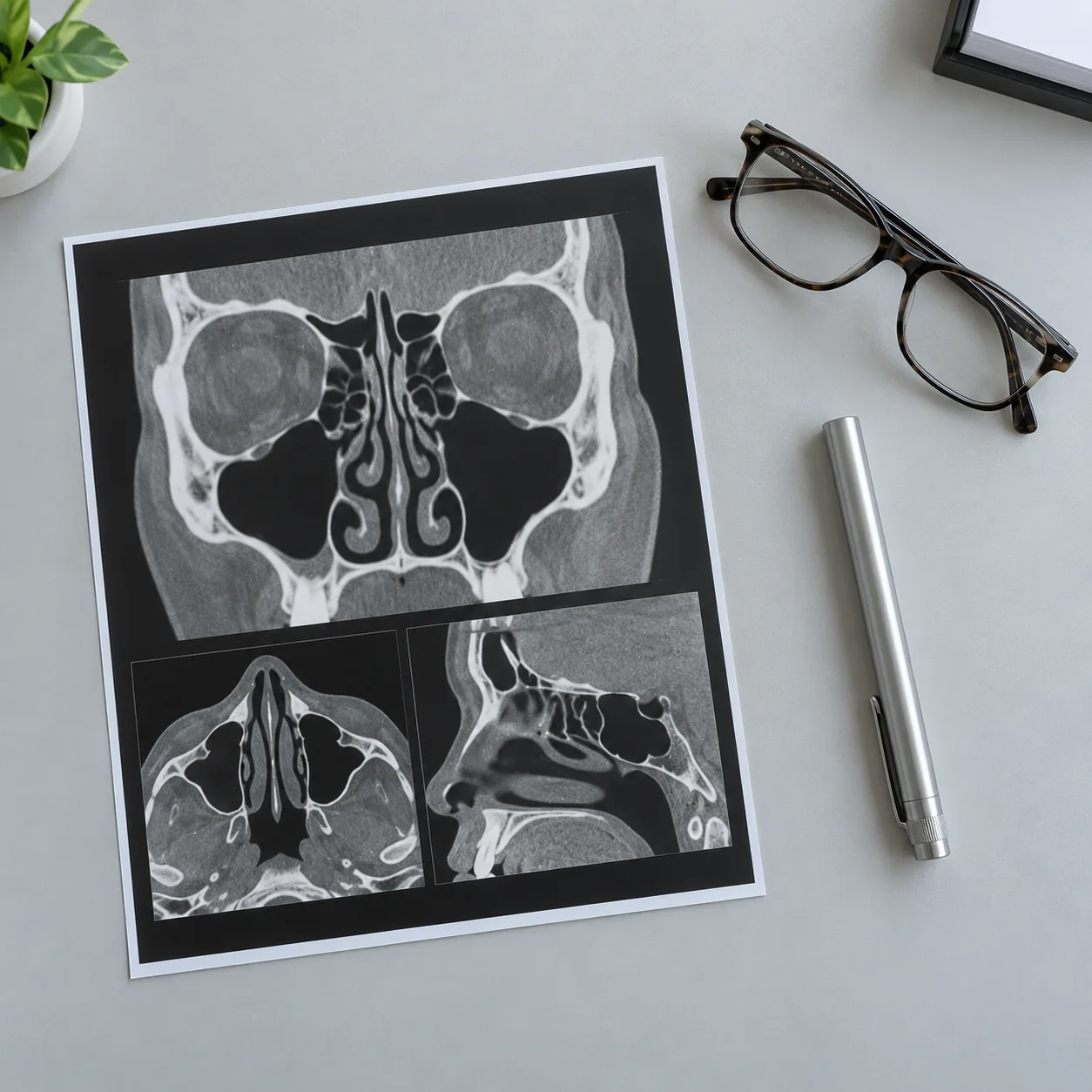
During your visit, our team will review your symptoms, medical history, and any treatments you have already tried. A nasal endoscopy uses a thin lighted scope to look inside the nose and sinuses. It shows things an external exam cannot. A CT scan of the sinuses is often the next step, and we have a scanner in the office, so it usually happens at the same visit rather than weeks later.
Based on these findings, our specialists will discuss whether continued medical management, surgery, or a combination of approaches makes the most sense for your situation. We believe in shared decision-making and will take time to answer your questions so you feel confident in your treatment plan.
Sources
- Shin JJ, Wilson M, McKenna M, et al. Clinical Practice Guideline: Surgical Management of Chronic Rhinosinusitis. Otolaryngology–Head and Neck Surgery. 2025;172(Suppl 2):S1-S47. doi:10.1002/ohn.1287
- DeConde AS, et al. Prevalence of polyp recurrence after endoscopic sinus surgery for chronic rhinosinusitis with nasal polyposis. The Laryngoscope. 2017;127(3):550-555.
- Loftus CA, Soler ZM, Desiato VM, et al. Factors impacting revision surgery in patients with chronic rhinosinusitis with nasal polyposis. International Forum of Allergy & Rhinology. 2020;10(3):289-302.
- Philpott C, Beard DJ, Saeedi E, et al. The clinical effectiveness of clarithromycin versus endoscopic sinus surgery for adults with chronic rhinosinusitis (MACRO): a pragmatic, multicentre, three-arm, randomised, placebo-controlled phase 4 trial. The Lancet. 2025;406(10506):926-939. doi:10.1016/S0140-6736(25)01248-6
- Payne SC, McKenna M, Buckley J, et al. Clinical Practice Guideline: Adult Sinusitis Update. Otolaryngology–Head and Neck Surgery. 2025;173(Suppl 1):S1-S56. doi:10.1002/ohn.1344
This article is for educational purposes only and does not replace an in-person evaluation.