Article
One Blocked Nostril: What It Can Mean
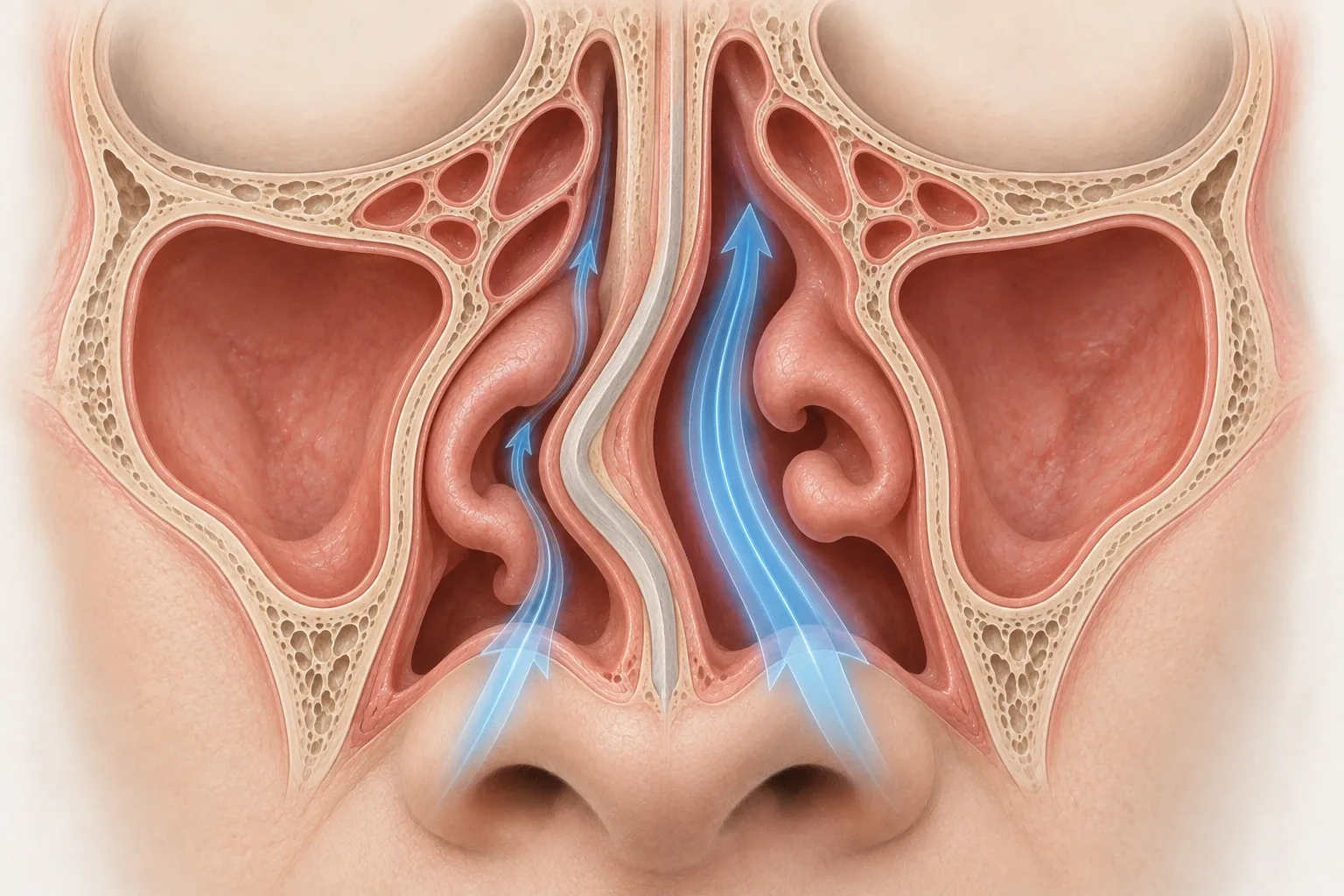
Quick answer: A nostril that feels blocked and then switches sides is usually the normal nasal cycle. A blockage that stays on the same side for weeks most often comes from a deviated septum, swollen turbinates, a weak nasal valve or a polyp, all of which are treatable. Because a steady one-sided blockage is also how rare growths in the nose first show up, see an ENT if it lasts, and be seen promptly for one-sided bleeding, a foul-smelling discharge, facial numbness or swelling, or vision changes (London et al., 2026). In a child, one blocked nostril with a smelly or bloody discharge often means something is stuck in the nose.
A stuffy nose is one of the most common reasons people see a doctor. When only one nostril is blocked, though, the pattern matters. Most causes are harmless and easy to treat, but a blockage that never moves off one side is the kind your ENT wants to look at directly. This article explains the usual causes, the warning signs to act on, and what an evaluation involves.
Is it normal for one nostril to be blocked?
Often, yes. The lining inside your nose naturally swells on one side and shrinks on the other, then switches, over a few hours. This is called the nasal cycle. Most people never notice it, but during a cold or allergy season it can make one nostril feel blocked, with the blocked side changing from one time of day to the next (Hsu and Suh, 2018).
A blockage that keeps switching sides is reassuring. A blockage that stays on the same side for weeks or months is worth having checked.
What usually causes one blocked nostril?
In adults and older children, a steady one-sided blockage usually has a structural or inflammatory cause (Villwock and Kuppersmith, 2018):
- Deviated septum. The wall between the two sides of the nose is off center and narrows one side. This is the most common cause of a blockage that never switches. See deviated septum.
- Swollen turbinates. Turbinates are ridges inside the nose that warm and moisten the air. Allergies or a deviated septum can make them swell and block one or both sides. See turbinate reduction.
- Nasal valve collapse. The narrowest part of the airway, just inside the nostril, can be weak and fall inward when you breathe in. See nasal valve repair.
- Nasal polyps. Soft, noncancerous swellings of the lining caused by long-standing inflammation. Ordinary polyps usually affect both sides, so a polyp on only one side gets a closer look (Payne et al., 2025).
- Antrochoanal polyp. A single polyp that grows out of the cheek sinus and back toward the throat, almost always on one side. It is more common in children and young adults (Choudhury et al., 2018).
What if my child has one blocked nostril?
Young children often put small objects in their nose: beads, foam, food, toy parts or batteries. The classic sign is one blocked nostril with a foul-smelling or bloody discharge from that side (D’Arco et al., 2023). Most objects can be removed in the office.
If your child may have put a button battery in the nose, go to the ER right away. A battery can burn the lining of the nose within hours.
What warning signs mean I should be seen soon?
Most one-sided blockage is not dangerous. These signs mean you should see an ENT promptly rather than waiting (London et al., 2026; Tunkel et al., 2020):
- Bloody discharge or repeated nosebleeds from the blocked side
- A foul-smelling discharge from one side
- Numbness, swelling or new pain in the face
- Vision changes, such as double vision or an eye that looks pushed forward
- A one-sided blockage in an adult that lasts for weeks and does not improve with usual treatment
These signs do not mean something serious is present. They are the features that make your ENT want to look further inside the nose and sometimes order a scan, because rare growths, both harmless ones and, less often, tumors, tend to first show up as one-sided symptoms and may not be visible from the front of the nose (Tunkel et al., 2020).
How do ENTs check a one-sided blockage?
- Your history and an exam. How long the blockage has lasted, whether it ever switches sides, and whether there is discharge, bleeding or other symptoms.
- A look further inside the nose. After a numbing spray, your ENT can use a small camera to see areas that cannot be seen from the front (nasal endoscopy). It takes a few minutes in the office and is the key step for one-sided symptoms (London et al., 2026).
- A scan if needed. A CT scan shows the bones and sinuses; we can do one in our office with our in-office CT scanner. An MRI is added when soft tissue needs a closer look.
- A biopsy, if a true growth is found. A small tissue sample tells exactly what it is. Some growths are best sampled in the operating room, so your ENT will plan this carefully.
How is a one-sided blockage treated?
Treatment depends on the cause. A deviated septum is corrected with septoplasty, often together with turbinate reduction. Allergy-related swelling usually improves with a steroid nasal spray and allergy care. Polyps are treated with medicine, removal or sinus surgery, and a weak nasal valve can be supported with nasal valve repair. An object in a child’s nose is removed, usually in the office.
Schedule a Nasal Evaluation
A nostril that switches sides is usually nothing to worry about. A blockage that stays on one side for weeks, or comes with bleeding, a bad-smelling discharge, facial numbness or vision changes, is worth an ENT visit. Most causes turn out to be benign and treatable, and an evaluation lets you know for sure.
Sources
- London NR Jr, Chiu J, Akhave NS, et al. Multidisciplinary consensus statement for appropriate evaluation and workup of sinonasal masses. JAMA Otolaryngology–Head & Neck Surgery. 2026;152(7):714-721. doi:10.1001/jamaoto.2026.1185. PMID: 42207510
- Tunkel DE, Anne S, Payne SC, et al. Clinical practice guideline: nosebleed (epistaxis). Otolaryngology–Head and Neck Surgery. 2020;162(1 Suppl):S1-S38. doi:10.1177/0194599819890327. PMID: 31910111
- Payne SC, McKenna M, Buckley J, et al. Clinical practice guideline: adult sinusitis update. Otolaryngology–Head and Neck Surgery. 2025;173(Suppl 1):S1-S56. doi:10.1002/ohn.1344. PMID: 40742114
- Hsu DW, Suh JD. Anatomy and physiology of nasal obstruction. Otolaryngologic Clinics of North America. 2018;51(5):853-865. doi:10.1016/j.otc.2018.05.001. PMID: 29941182
- Villwock JA, Kuppersmith RB. Diagnostic algorithm for evaluating nasal airway obstruction. Otolaryngologic Clinics of North America. 2018;51(5):867-872. doi:10.1016/j.otc.2018.05.002. PMID: 30057071
- Choudhury N, Hariri A, Saleh H, Sandison A. Diagnostic challenges of antrochoanal polyps: a review of sixty-one cases. Clinical Otolaryngology. 2018;43(2):670-674. doi:10.1111/coa.12993. PMID: 28965368
- D’Arco F, Lee P, Siddiqui A, Nash R, Ugga L. Radiologic diagnosis of non-traumatic paediatric head and neck emergencies. Pediatric Radiology. 2023;53(4):768-782. doi:10.1007/s00247-022-05556-8. PMID: 36481939
This article is for educational purposes only and does not replace an in-person evaluation.