Article
Fluid Behind the Eardrum in Children: What Parents Should Know
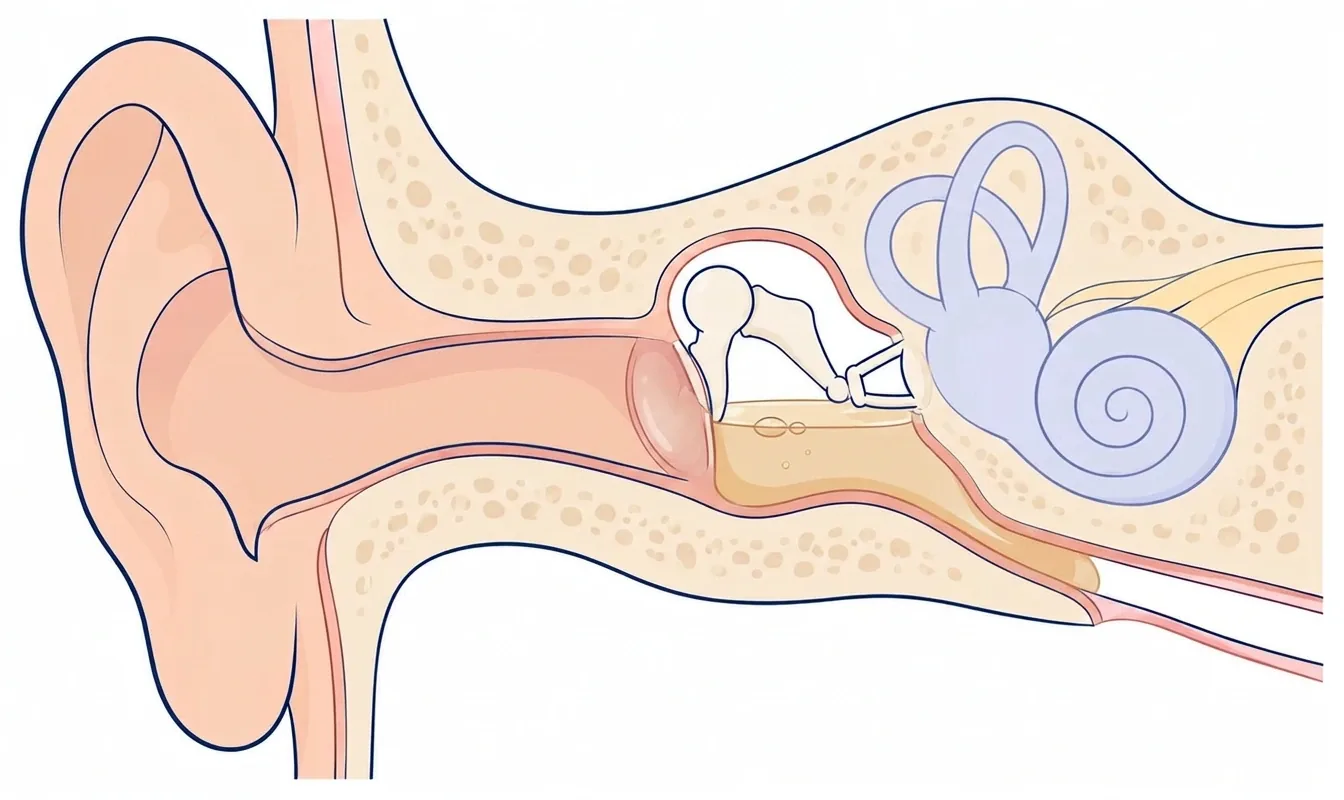
Quick answer: Fluid behind the eardrum, called otitis media with effusion, is very common in young children and usually clears on its own, most often within about 3 months. It can muffle hearing, often without pain or fever. Antibiotics, steroids, antihistamines and decongestants are not recommended for it. If it lasts 3 months or longer, a hearing test is recommended and ear tubes may be an option.
Your child's pediatrician may have mentioned fluid behind the eardrum, or your child may seem not to hear you as well as usual. Ear fluid is very common and usually clears without treatment. Here is what it is, what helps, what does not, and when ear tubes or other care make sense.
What Is Fluid Behind the Eardrum?
The middle ear is a small, air-filled space behind the eardrum. Otitis media with effusion (OME) means fluid has collected in that space without signs of an active ear infection. The fluid can be thin and watery or thick and sticky, which is why it is sometimes called "glue ear."
It is different from an acute ear infection. An ear infection usually causes ear pain, often with fever, and the eardrum looks inflamed. With OME the fluid is not actively infected, and pain is mild or absent, so it is easy to miss. Nearly all children have ear fluid at least once by school age.
What Causes Fluid Behind the Eardrum?
The Eustachian tube connects the middle ear to the back of the nose and keeps air pressure even. It is shorter and flatter in young children and does not work as well, so fluid can collect. Common triggers and risk factors include:
- Colds and ear infections: Fluid often appears after a cold, or stays behind for weeks after an ear infection has cleared.
- Tobacco smoke: Keep your child away from all smoke and vaping.
- Day care: Children in group care catch more colds, and ear fluid is more common among them.
- Allergies: These may play a part, but the evidence is less clear.
- The adenoid: This pad of tissue sits at the back of the nose, near the openings of the Eustachian tubes, and may contribute. See our article on an enlarged adenoid in children.
Often no single cause is found.
What Are the Signs of Fluid Behind the Eardrum?
Many children have no obvious symptoms, and the fluid is found at a routine visit. Muffled hearing is the main effect. You or a teacher may notice that your child:
- Does not respond when called, or often says "what?"
- Turns up the TV or tablet
- Has ear discomfort, or rubs the ears
- Seems clumsy or has balance problems
- Has trouble in school or with behavior
- Sleeps poorly
Hearing loss that lasts can affect speech and language, so it is worth checking. Researchers are still working out how much mild, temporary hearing loss affects speech in otherwise healthy children.
How Is Fluid Behind the Eardrum Diagnosed?
We look at the eardrum with a pneumatic otoscope, a small handheld light that gently puffs air to see how well the eardrum moves. The AAO-HNS guideline recommends this as the main test. If the answer is still unclear, tympanometry, a quick and painless test of eardrum movement, can confirm it.
A hearing test is recommended if fluid lasts 3 months or longer or before ear tube surgery. It is also recommended at any point for a child at higher risk of speech or learning problems.
Does Fluid Behind the Eardrum Go Away on Its Own?
Usually, yes. Most fluid clears in weeks to a few months, especially after a cold or an ear infection. Fluid that has already lasted 3 months or longer is slower to clear, and it can come back with later colds.
That is why the guideline recommends watchful waiting for 3 months from when the fluid started, or from diagnosis if the start date is unknown, for children who are not at higher risk. If long-lasting fluid is being watched rather than treated, we recheck about every 3 to 6 months. We keep going until the fluid is gone, or until significant hearing loss or changes in the eardrum mean it is time to do more.
While you wait, it helps to get close and face your child when you talk, turn off background noise, and ask the teacher to seat your child near the front of the class.
Do Medicines Help Fluid Behind the Eardrum?
In general, no. The guideline recommends against antibiotics, oral or nasal steroids, antihistamines and decongestants for ear fluid. They have not been shown to give lasting benefit, and they can have side effects. In a large trial of oral steroids in children with hearing loss from ear fluid, 40% had acceptable hearing at 5 weeks with steroids and 33% with placebo. That difference was too small to rule out chance, and quality of life was no better.
Your child may still need medicine for something else, such as an ear infection or allergies.
When Are Ear Tubes Recommended?
Ear tubes are tiny vents placed in the eardrum that let air in and fluid out. Placement takes 5 to 10 minutes, and tubes usually stay in for 6 to 18 months before falling out on their own. The AAO-HNS tube guideline says to offer them when:
- Fluid has been in both ears for 3 months or longer and hearing difficulty is documented.
They are also an option when fluid has lasted 3 months or longer in one or both ears and is likely causing symptoms such as balance problems, ear discomfort, or trouble at school or with behavior. Tubes are not recommended for a single episode that has lasted less than 3 months, unless a child at higher risk has fluid that looks unlikely to clear soon.
In a review of the research, children with long-lasting fluid heard better 1 to 3 months after tubes than children who waited. By 1 to 2 years, hearing was about the same in both groups. Results vary from person to person, and study numbers cannot predict your own child's result.
Drainage from the ear happens in up to 1 in 4 people with tubes, and we treat it with antibiotic ear drops. A hole can stay in the eardrum after the tube falls out in about 2 in 100 cases with short-term tubes. Scarring of the eardrum is also possible and usually causes no symptoms. We see children about 2 weeks after surgery and then about every 6 months until the tubes come out. Our before-surgery guide and recovery guide have the details.
Is Adenoid Surgery Ever Needed?
Sometimes. For a child under 4, the guideline recommends ear tubes alone when surgery is needed, unless there is a separate reason to remove the adenoid, such as a blocked nose or a chronic adenoid infection. For a child 4 or older, the options are tubes, adenoidectomy or both, and we decide together with you.
When Should You See a Specialist?
Make an appointment with an ENT specialist if your child:
- Has had fluid for 3 months or longer, especially in both ears
- Did not pass a hearing screen or test, or seems to have trouble hearing
- Has a speech or language delay, or problems with school, behavior or balance
- Has repeated episodes of fluid, or fluid along with repeated ear infections
- Has been told the eardrum looks pulled in or damaged
Some children should be seen sooner, whatever the duration of the fluid, because they are at higher risk of speech, language or learning problems. These include children with permanent hearing loss, a speech or language delay, autism or another developmental delay, Down syndrome, cleft palate or another craniofacial condition.
Sources
- Rosenfeld RM, Shin JJ, Schwartz SR, et al. Clinical Practice Guideline: Otitis Media with Effusion (Update). Otolaryngology-Head and Neck Surgery. 2016;154(1 Suppl):S1-S41. PubMed
- Rosenfeld RM, Tunkel DE, Schwartz SR, et al. Clinical Practice Guideline: Tympanostomy Tubes in Children (Update). Otolaryngology-Head and Neck Surgery. 2022;166(1 Suppl):S1-S55. PubMed
- Francis NA, Cannings-John R, Waldron CA, et al. Oral steroids for resolution of otitis media with effusion in children (OSTRICH). Lancet. 2018;392(10147):557-568. PubMed
- Steele DW, Adam GP, Di M, et al. Effectiveness of Tympanostomy Tubes for Otitis Media: A Meta-analysis. Pediatrics. 2017;139(6):e20170125. PubMed
- American Academy of Otolaryngology-Head and Neck Surgery. Understanding Ear Fluid. ENT Health. ENT Health
- American Academy of Otolaryngology-Head and Neck Surgery. Ear Tubes. ENT Health. ENT Health
This article is for educational purposes only and does not replace an in-person evaluation.