
Before-surgery guide
Getting Ready for Tympanoplasty
Quick answer: Tympanoplasty repairs a hole in the eardrum with a graft, a thin piece of your own tissue, usually taken from the muscle covering behind the ear or from the cartilage just in front of the ear canal. It is done under general anesthesia, and most people go home the same day and go back to work or school the next day. Until your surgeon clears you, usually at least 1 month, you will need to keep the ear dry, not blow your nose forcefully, and avoid heavy lifting and strenuous activity.
How is the surgery done?
- The surgery is done under general anesthesia (completely asleep).
- The edges of the hole in the eardrum are trimmed and material is placed to help it seal.
- A graft, a thin piece of tissue from the muscle covering behind your ear, is used to repair the eardrum. Your surgeon will tell you whether a small incision behind the ear is needed to take it.
- Sometimes a small piece of cartilage is taken from the tragus, the small flap in front of the ear canal, instead. This does not change how the ear looks.
- Packing is placed in the middle ear and the ear canal to hold the graft in place.
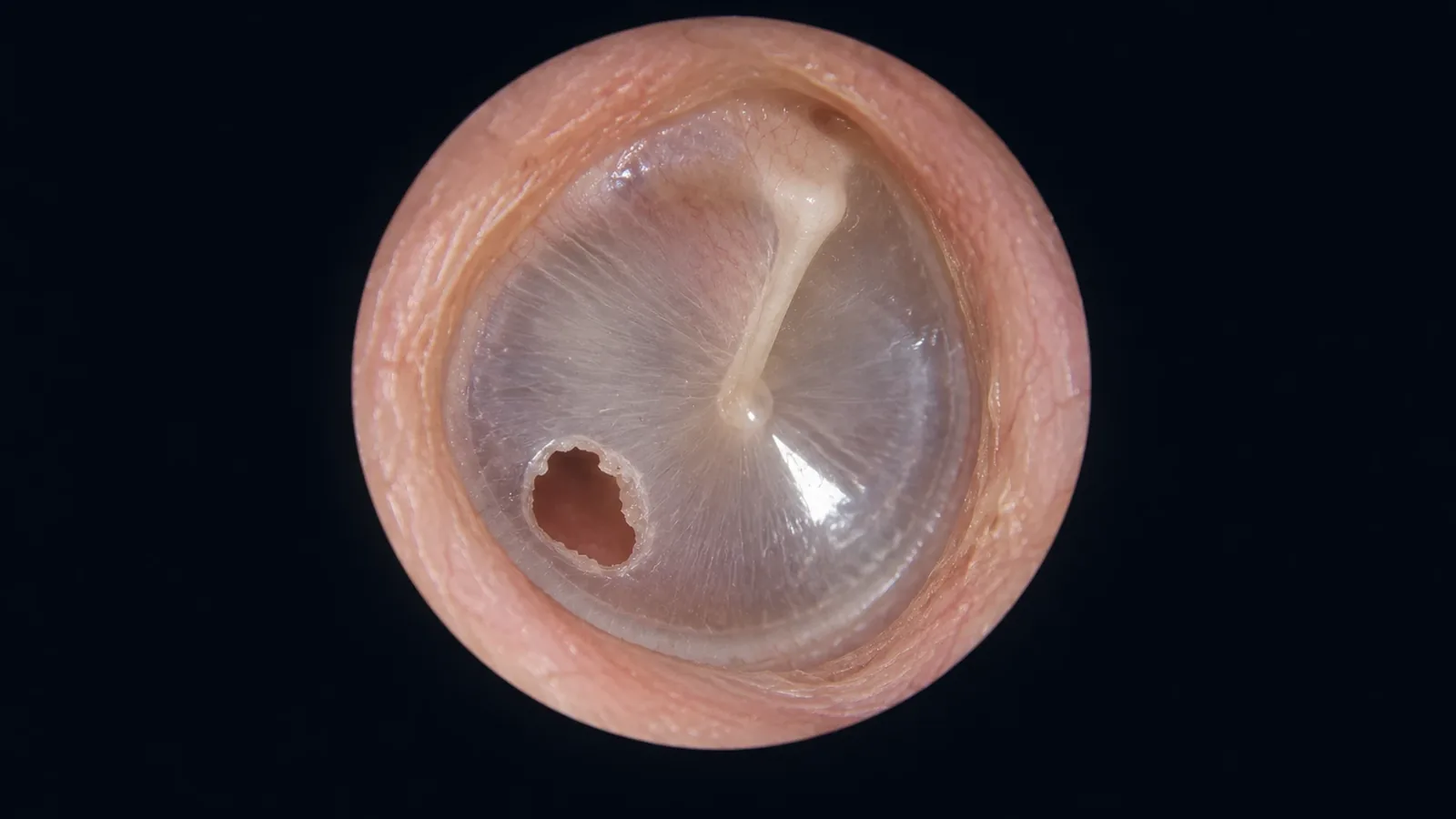
A hole in the eardrum, as seen through an ear scope. The repair closes the hole.
What are the risks?
Every surgery has risks. Your surgeon will go over them with you before surgery, and you can ask about any of them.
- Anesthesia is safe, but it has some risks. The anesthesia team can go over them with you. Tell us if anyone in your family has had a problem with anesthesia.
- Pain, bleeding and infection are risks of any surgery.
- Hearing loss. There is a small risk of hearing loss or worse hearing with any ear surgery.
- Dizziness may happen for several days after surgery.
- Cholesteatoma, a skin cyst behind the eardrum, is a small risk. It can cause long-lasting infections and hearing loss, sometimes years after surgery.
- The graft may not take. The graft may not heal in place, and surgery may need to be repeated. In a large review of studies, this happened in about 1 to 2 in 10 people, more often when the hole was large.
How do I get ready?
-
As soon as surgery is scheduled
- Give us a list of every medicine, vitamin and supplement you take. We will tell you which to stop and when.
- If you smoke or vape, stop now. Stopping helps your body heal and makes anesthesia safer, and the earlier you stop, the better: aim for at least 4 weeks before surgery, though even 2 weeks helps. Stay off until your surgeon says you have healed.
- Plan time off. Most people go back to work or school the next day.
- Plan ahead for the limits afterward: no swimming, heavy lifting or strenuous activity until your surgeon clears you, usually at least 1 month.
- Arrange for an adult to drive you home. After general anesthesia, we recommend having an adult stay with you the first night.
-
1 to 2 weeks before
- Aspirin is usually stopped 1 to 2 weeks before surgery. If you take aspirin or a blood thinner for your heart, a stent or stroke prevention, do not stop it on your own: your surgeon will check with whoever prescribes it.
- Ask us whether to pause ibuprofen (Advil, Motrin) or naproxen (Aleve).
- Ask about herbal remedies and supplements, such as fish oil, vitamin E, ginkgo or garlic pills, which can raise the chance of bleeding.
- If you take insulin or other diabetes medicines, ask how to take them before surgery.
- Get the supplies in the next section.
-
The night before
- Follow the eating and drinking instructions from our office or the surgery center exactly. If you eat or drink when you should not, surgery may need to be postponed for safety.
- Many places ask for nothing to eat after midnight, and some allow clear liquids until a few hours before.
- Take only the medicines we said to take that morning, with a small sip of water.
- Get a good night’s sleep.
-
The day of surgery
- Wear comfortable clothes.
- Wear glasses instead of contact lenses, and leave jewelry and valuables at home.
- Bring your photo ID, insurance card and list of medicines.
What should I have at home?
- Cotton balls and petroleum jelly (Vaseline), to keep the ear dry in the shower
- Nasal saline spray, for a stuffy nose instead of blowing
- Acetaminophen (Tylenol) and ibuprofen (Advil, Motrin), unless your surgeon told you not to take ibuprofen
What happens after surgery?
- Most people go home the same day and go back to work or school the next day.
- Until your surgeon clears you, usually at least 1 month: keep water out of the ear, do not blow your nose forcefully, sneeze with your mouth open, and avoid heavy lifting and strenuous activity. This keeps the graft in place.
- Mild drainage from the ear can be normal at first.
The Tympanoplasty Recovery Guide has everything you need after the procedure, including when to call us.
When should I call before surgery?
Call us for
- You get a cold, fever, sore throat or other illness in the week before surgery
- You start a new medicine, or a doctor changes your blood thinner
- You could be pregnant
- You have questions about the procedure or its risks, or you need to reschedule
Austin 512-339-4040 · Lakeway 512-682-4798 · Marble Falls 830-992-2830
Questions patients ask
A thin piece of your own tissue, usually from the muscle covering behind the ear, or sometimes cartilage from the tragus in front of the ear canal, used as a patch to close the hole in the eardrum. Taking cartilage from the tragus does not change how the ear looks.
In a large review of studies, the hole closed in about 9 in 10 people when it was smaller and in about 8 in 10 when it was larger. Results vary from person to person, and study numbers cannot predict your own result. If the graft does not take, surgery may need to be repeated.
Not until your surgeon clears you at a follow-up visit, usually at least 1 month after surgery.
This guide is for educational purposes only and does not replace an in-person evaluation. If your surgeon gave you different instructions, follow theirs.
Sources
- Joshi GP, Abdelmalak BB, Weigel WA, et al. 2023 American Society of Anesthesiologists Practice Guidelines for Preoperative Fasting. Anesthesiology. 2023;138(2):132-151. PubMed
- Jungbauer WN Jr, Jeong S, Nguyen SA, Lambert PR. Comparing myringoplasty to type I tympanoplasty in tympanic membrane repair: a systematic review and meta-analysis. Otolaryngology–Head and Neck Surgery. 2023;168(5):922-934. PubMed