Article
BPPV and the Epley Maneuver: Understanding Positional Vertigo
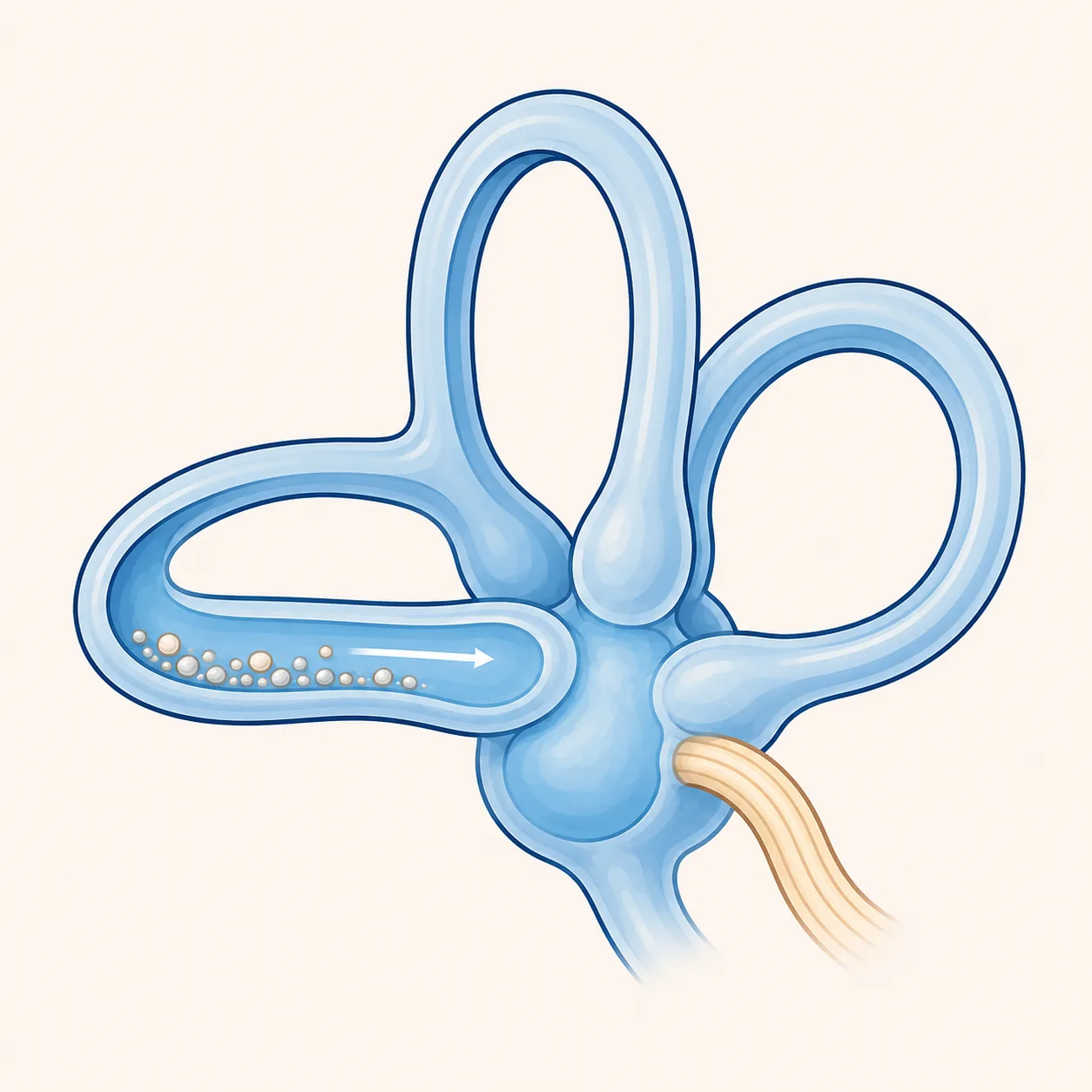
Quick answer: BPPV is the most common cause of vertigo. Tiny calcium crystals come loose in the inner ear and drift into a balance canal where they do not belong, so certain head movements set off brief, intense spinning, usually under a minute. It is not a sign of anything serious, but a sudden spell can cause a fall, especially in older adults. There is a mechanical fix: the Epley maneuver repositions the crystals, and most people improve after one or two sessions. Two things worth knowing before you try it at home. The maneuver is side-specific, so it only works if you know which ear is involved, and the AAO-HNS BPPV guideline is explicit that vertigo medications like meclizine are overused here and scans are usually unnecessary. Getting the diagnosis right first is what makes the treatment work.
You roll over in bed and the room lurches into a spin. It settles within a minute, but it happens again the next time you tip your head back, or bend down, or look up at a shelf. That pattern, brief spinning tied to specific head positions, is the signature of benign paroxysmal positional vertigo, better known as BPPV. That name is worth unpacking, because every word of it tells you something: benign means it is not dangerous, paroxysmal means it comes in sudden short bursts, positional means head position sets it off, and vertigo is the spinning itself.
It is unsettling, and patients often arrive convinced something serious is happening. The reassuring part is that BPPV is both the most common cause of vertigo and one of the few conditions in medicine with a genuinely mechanical solution.
What Is BPPV?
BPPV is one of the most common causes of vertigo, which is the false sensation that you or your surroundings are spinning or moving. The condition occurs when tiny calcium carbonate crystals called otoconia become dislodged from their normal location in the inner ear and migrate into one of the semicircular canals. These canals are filled with fluid and are responsible for detecting rotational head movements.
When these displaced crystals shift with head movement, they send confusing signals to the brain about your position in space. This mismatch between what your inner ear senses and what your eyes see creates the characteristic spinning sensation of vertigo.
Common triggers for BPPV episodes may include:
- Rolling over in bed
- Tilting your head back (such as looking up at a high shelf)
- Bending forward
- Quick head movements
Episodes are often brief, typically lasting less than a minute, but can be intense and may cause nausea or imbalance. While BPPV is not a sign of anything serious, it can significantly impact daily activities and increase the risk of falls, particularly in older adults.
What Causes BPPV?
Often there is no identifiable cause, and that is a normal answer rather than a missed one. When there is a trigger, the usual suspects are a head injury, an inner ear infection, a long stretch of bed rest, or simply age-related change in the inner ear. BPPV can also follow ear surgery or occur alongside other inner ear conditions.
Age matters here. BPPV becomes more common as people get older, and in older adults the stakes are higher because a sudden spinning episode raises the risk of a fall.
BPPV is not the only condition that causes vertigo, and the differences are worth knowing. Meniere's disease causes attacks lasting 20 minutes to 12 hours, and brings hearing loss, ringing, and ear fullness with them (AAO-HNS Meniere's guideline). BPPV attacks last under a minute and do not affect hearing at all. Vestibular migraine is another common look-alike. Our guide to dizziness and imbalance walks through the broader list.
How the Epley Maneuver Works
The Epley maneuver is a sequence of head and body positions that walks the loose crystals back out of the balance canal and into a part of the inner ear where they stop causing trouble. Clinicians call it canalith repositioning. It sounds improbable, and it works.
You lie back on an exam table and we guide you through a sequence of four head and body positions, moving from sitting, to lying back, to rolling onto your side, and back up to sitting. Each position is held until the spinning settles, generally at least 20 to 30 seconds, so gravity can carry the crystals along (Kim and Zee, New England Journal of Medicine, 2014). We usually repeat the sequence two or three times in a visit, which improves the odds. Some people feel briefly nauseated during it, which passes.
Two things to expect afterward. Relief often arrives over the next 24 to 48 hours rather than the moment you sit up. And the numbers are good: roughly 80 percent of patients are better after a single session, rising to about 92 percent when the maneuver is repeated up to four times (Cochrane review). Most people improve after one or two sessions.
The AAO-HNS guideline strongly recommends repositioning maneuvers like the Epley for posterior canal BPPV, the most common form (Bhattacharyya et al., Otolaryngology–Head and Neck Surgery, 2017).
Should You Try the Epley at Home?
This is the question we get most, and the honest answer is: not until you know what you are treating.
The maneuver is side-specific and canal-specific. Performed toward the wrong ear, it does nothing. Performed for the wrong canal, it can move crystals somewhere less helpful. And if the vertigo is not BPPV at all, no amount of repositioning will touch it, while the real cause goes unaddressed.
Diagnosis comes from a positioning test called the Dix-Hallpike, where we tip your head into a specific position and watch your eyes. The involuntary eye movement that follows tells us which ear and which canal are affected. That takes a minute in the office, and it is what makes the treatment reliable rather than a coin flip.
Once you have been diagnosed and shown the correct version, home repositioning is a reasonable tool for recurrences, and there is good evidence behind that: a randomized trial in JAMA Neurology found self-treatment effective for recurrent BPPV in patients who had already been diagnosed and instructed (Kim et al., 2023). Starting there without a diagnosis is the part we would steer you away from. Once you know which ear is affected, our guide to managing BPPV at home walks through the home Epley step by step.
What the Guideline Says About Medications and Scans
Two of the guideline's stated aims are worth passing along, because they run against what many patients expect.
Vertigo medications are overused for BPPV. Drugs like meclizine suppress the sensation of spinning, but they do nothing about the crystals causing it, and they can leave you sedated. The guideline explicitly aims to reduce inappropriate use of vestibular suppressants.
Imaging is usually unnecessary. A CT or MRI cannot show BPPV. The guideline aims to decrease inappropriate use of radiographic imaging, so if we do not order a scan, that is the standard of care rather than a shortcut.
What the guideline does want more of is the repositioning maneuver itself.
When Should You See a Specialist?
First, the symptoms that mean it is not BPPV and need emergency care. Call 911 or go to an emergency room if vertigo comes with any of these:
- Sudden severe headache, or the worst headache of your life
- Double vision, or trouble seeing
- Weakness or numbness in the face, arm, or leg
- Slurred speech or trouble finding words
- Trouble walking beyond what the spinning explains
- Vertigo that is constant rather than coming in brief position-triggered bursts
Those can signal a problem in the brain rather than the inner ear, and they are treated as time-sensitive. BPPV does not cause them.
Short of that, book an appointment with an ENT if you have:
- Repeated spinning episodes set off by head movements
- Dizziness that gets in the way of work, driving, or daily life
- Nausea or unsteadiness when you change position
- Symptoms that have not settled on their own after a few days
- Any hearing change, ear fullness, or ringing along with the vertigo, which points away from BPPV and toward something like Meniere's disease
Getting vertigo properly evaluated matters because the treatments diverge completely. The repositioning maneuver that resolves BPPV in minutes does nothing for vestibular migraine or Meniere's, and vice versa.
What to Expect at Capital ENT
We start with your history, since the pattern of your symptoms carries most of the diagnostic weight. How long do the episodes last? What sets them off? Is your hearing involved? Then we perform the Dix-Hallpike positioning test to identify which ear and canal are responsible.
If it is BPPV, we can usually treat it in the same visit. Repositioning takes a few minutes, and many patients walk out noticeably better than they walked in. We will also go over what to do if it comes back, which happens for some people, and when a home maneuver is appropriate.
Our board-certified ENTs evaluate vertigo and balance problems regularly, with on-site audiology when hearing needs to be tested as part of the workup. You can see us at any of our Austin-area locations.
Sources
- Kim JS, Zee DS. Benign Paroxysmal Positional Vertigo. The New England Journal of Medicine. 2014;370(12):1138-1147. doi:10.1056/NEJMcp1309481. PMID: 24645946
- Kim HJ, Kim JS, Choi KD, et al. Effect of Self-treatment of Recurrent Benign Paroxysmal Positional Vertigo. JAMA Neurology. 2023;80(3):244-250. doi:10.1001/jamaneurol.2022.4944. PMID: 36648931
- Hilton MP, Pinder DK. The Epley (canalith repositioning) manoeuvre for benign paroxysmal positional vertigo. Cochrane Database of Systematic Reviews. 2014;(12):CD003162. doi:10.1002/14651858.CD003162.pub3. PMID: 25485940
- Bhattacharyya N, Gubbels SP, Schwartz SR, et al. Clinical Practice Guideline: Benign Paroxysmal Positional Vertigo (Update). Otolaryngology–Head and Neck Surgery. 2017;156(3_suppl):S1-S47. doi:10.1177/0194599816689667. PMID: 28248609
- Basura GJ, et al. Clinical Practice Guideline: Meniere's Disease. Otolaryngology–Head and Neck Surgery. 2020. PMID: 32267799
This article is for educational purposes only and does not replace an in-person evaluation.