
Before-surgery guide
Getting Ready for Inspire Surgery
Quick answer: Inspire is an implanted device for obstructive sleep apnea. It is placed under general anesthesia through two incisions about 2 inches long, one in the upper neck and one in the chest, usually on the right side, and most people go home the same day. Recovery is easy for most people. For 1 week, avoid heavy lifting, strenuous activity and swimming; for 2 weeks, do not reach overhead or lift much with the arm on the side of the implant. The device is turned on in our office about 1 month after surgery.
How is the surgery done?
- Inspire is an implanted device for obstructive sleep apnea. During sleep it gently stimulates the nerve that moves the tongue, with the goal of keeping the airway open.
- The surgery is done under general anesthesia (completely asleep).
- Two incisions about 2 inches long are made: one in the upper neck under the jawbone and one in the chest over the chest muscle. They are usually on the right side.
- The stimulation lead is placed in the neck, and the breathing sensor and the device (generator) are placed in the chest.
- The system is tested during surgery to make sure it is working. The incisions are closed with dissolving stitches and skin glue.
- Most people go home the same day.
Our Inspire page explains who Inspire helps.
What are the risks?
Every surgery has risks. Your surgeon will go over them with you before surgery, and you can ask about any of them.
- Anesthesia is safe, but it has some risks. The anesthesia team can go over them with you. Tell us if anyone in your family has had a problem with anesthesia.
- Pain, bleeding and infection are risks of any surgery.
- Injury to nerves or blood vessels near the surgery sites.
- Numbness or pain around the incisions.
- Weakness of the lower face, temporary or permanent.
- Tongue weakness, temporary or permanent, which could cause trouble swallowing or speaking.
- Tongue soreness or discomfort from the stimulation.
- A collapsed lung (pneumothorax), which could need more procedures to treat.
- Scars where the incisions were made.
- Sleep apnea may not be treated well enough, and more procedures may be needed.
How do I get ready?
-
As soon as surgery is scheduled
- Give us a list of every medicine, vitamin and supplement you take. We will tell you which to stop and when.
- If you smoke or vape, stop now. Stopping helps your body heal and makes anesthesia safer, and the earlier you stop, the better: aim for at least 4 weeks before surgery, though even 2 weeks helps. Stay off until your surgeon says you have healed.
- Plan time off. Plan on at least several days off work or school; some people feel ready sooner.
- Plan your travel. For 1 week after surgery, stay within about an hour of our office or an emergency room, and do not fly.
- Arrange for an adult to drive you home. After general anesthesia, we recommend having an adult stay with you the first night.
-
1 to 2 weeks before
- Aspirin is usually stopped 1 to 2 weeks before surgery. If you take aspirin or a blood thinner for your heart, a stent or stroke prevention, do not stop it on your own: your surgeon will check with whoever prescribes it.
- Ask us whether to pause ibuprofen (Advil, Motrin) or naproxen (Aleve).
- Ask about herbal remedies and supplements, such as fish oil, vitamin E, ginkgo or garlic pills, which can raise the chance of bleeding.
- If you take insulin or other diabetes medicines, ask how to take them before surgery.
- Get the supplies in the next section.
-
The night before
- Follow the eating and drinking instructions from our office or the surgery center exactly. If you eat or drink when you should not, surgery may need to be postponed for safety.
- Many places ask for nothing to eat after midnight, and some allow clear liquids until a few hours before.
- Take only the medicines we said to take that morning, with a small sip of water.
- Get a good night’s sleep.
-
The day of surgery
- Wear comfortable clothes.
- Wear glasses instead of contact lenses, and leave jewelry and valuables at home.
- Bring your photo ID, insurance card and list of medicines.
- We will tell you your arrival time before the day of surgery. It is usually about 1 hour before surgery.
What should I have at home?
- Acetaminophen (Tylenol) and ibuprofen (Advil, Motrin), unless your surgeon told you not to take ibuprofen
What happens after surgery?
- Most people go home the same day. You do not need bed rest: most people are back to normal, non-strenuous activity within a few days, usually with over-the-counter pain medicine only.
- For 1 week: no heavy lifting, strenuous activity or swimming.
- For 2 weeks: do not reach overhead, and lift little to no weight with the arm on the side of your implant (usually the right).
- Your device stays off while you heal. It is turned on in our office about 1 month after surgery. Until then, ask us whether to keep using your CPAP if you have one.
The Inspire Recovery Guide has everything you need after the procedure, including when to call us.
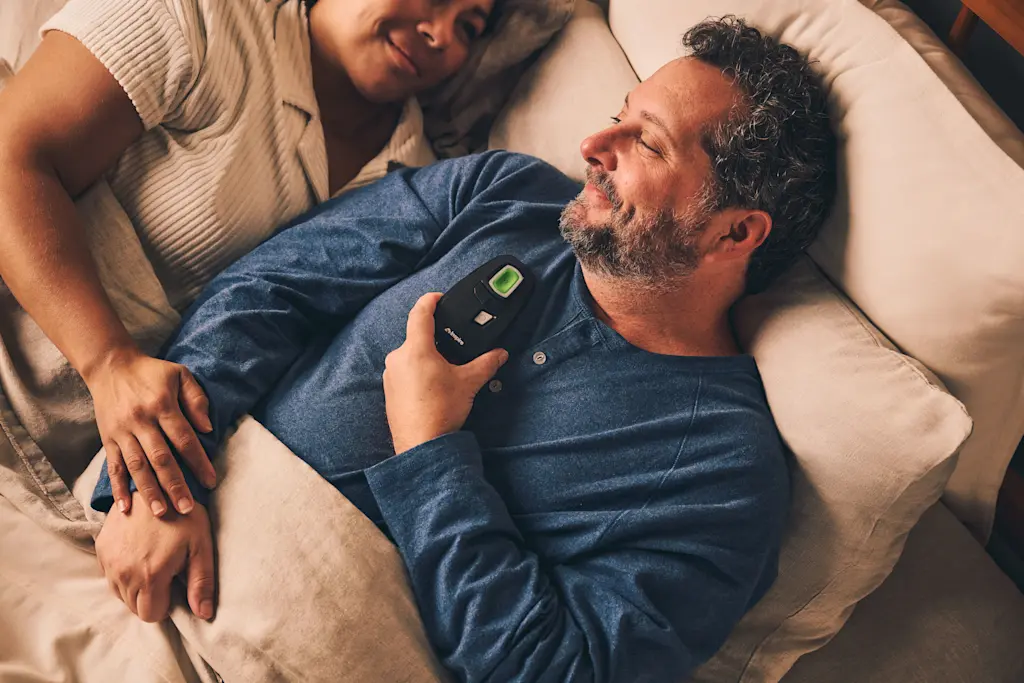
Using Inspire at night. Once your device is turned on, you start it each night with a small remote.
When should I call before surgery?
Call us for
- You get a cold, fever, sore throat or other illness in the week before surgery
- You start a new medicine, or a doctor changes your blood thinner
- You could be pregnant
- You have questions about the procedure or its risks, or you need to reschedule
Austin 512-339-4040 · Lakeway 512-682-4798 · Marble Falls 830-992-2830
Questions patients ask
Recovery is easy for most people: most are back to normal, non-strenuous activity within a few days. For 1 week, avoid heavy lifting, strenuous activity and swimming. For 2 weeks, do not reach overhead, and lift little to no weight with the arm on the side of your implant.
About 1 month after surgery, in our office, once you have healed. We set it up and show you how to use the remote.
One in the upper neck under the jawbone and one in the chest, each about 2 inches long, usually on the right side.
This guide is for educational purposes only and does not replace an in-person evaluation. If your surgeon gave you different instructions, follow theirs.
Sources
- Joshi GP, Abdelmalak BB, Weigel WA, et al. 2023 American Society of Anesthesiologists Practice Guidelines for Preoperative Fasting. Anesthesiology. 2023;138(2):132-151. PubMed
- Tang E, Rodriguez RM, Srivastava A, et al. Impact of short duration smoking cessation on post-operative complications: a systematic review and meta-analysis. Journal of Clinical Anesthesia. 2025;106:111967. PubMed