Article
Airplane Ear: Why Your Ears Hurt When You Fly, and How to Prevent It
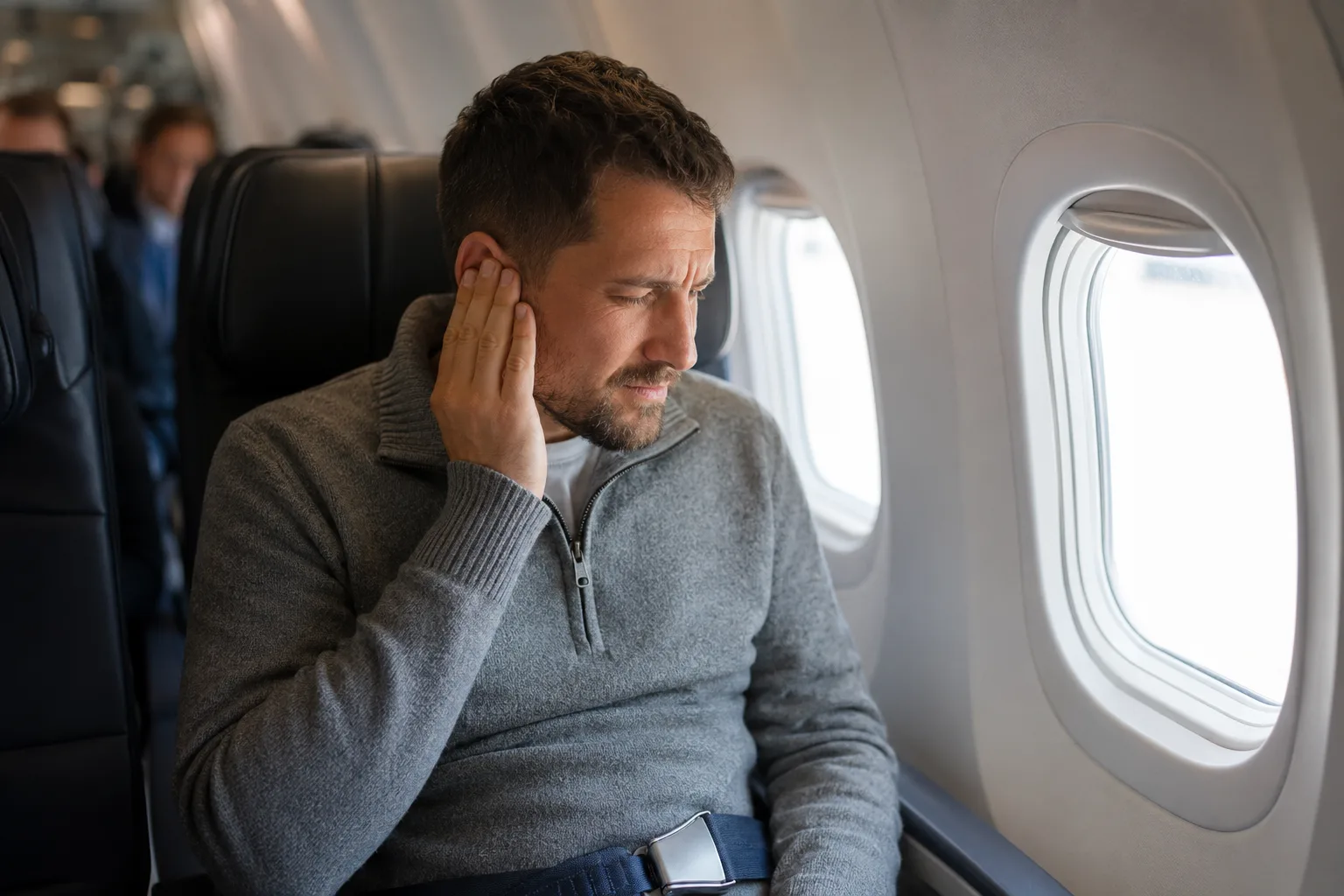
Quick answer: Airplane ear (ear barotrauma) happens when the eustachian tube cannot equalize the pressure in your middle ear as the cabin pressure changes, which is why pain and fullness usually peak during descent. Most cases are prevented by swallowing, yawning, or chewing gum starting before descent, staying awake for landing, and, for adults, an oral pseudoephedrine decongestant taken 30 to 60 minutes before the flight, which is the best-supported preventive measure. Ears that stay blocked usually clear within hours to a few days. See an ENT if fullness or muffled hearing lasts more than a few days, and promptly if you have severe pain, drainage, vertigo, or a sudden drop in hearing.
If your ears have ever ached, felt stuffed up, or refused to "pop" on a flight, you have experienced what is commonly called airplane ear. It is one of the most common medical complaints among air travelers, and for most people it is uncomfortable but temporary. Understanding why it happens, and the simple steps that prevent it, can make your next trip far more comfortable. At Capital ENT & Sinus Center, our board-certified specialists help patients across Central Texas who struggle with ear pressure when they fly.
What Is Airplane Ear?
Airplane ear, known medically as otic barotrauma (a pressure-related ear injury), happens when the air pressure inside your middle ear cannot keep up with the changing pressure in the cabin around you. These two spaces are connected by the eustachian tube, a narrow passage about the width of a pencil lead that links the middle ear to the back of the nose. Each time you swallow or yawn, this tube briefly opens to let air in or out, keeping the pressure on both sides of your eardrum balanced.
Even though an airplane cabin is pressurized, it is not pressurized all the way to sea level. During a typical flight, the cabin feels more like an elevation of roughly 5,000 to 8,000 feet. As the plane climbs and descends, the air sealed inside your middle ear expands and contracts, and your eustachian tube has to open often enough to keep up. When it cannot, a pressure difference builds against the eardrum and produces the symptoms of airplane ear.
Why Descent Is the Hardest Part
Most people feel airplane ear far more on the way down than on the way up. During ascent, the air in the middle ear is at a higher pressure than the cabin, so it tends to escape through the eustachian tube fairly easily, almost on its own. During descent, the opposite happens: cabin pressure rises and the middle ear develops a relative vacuum, so the eustachian tube has to actively open to pull air back in. That is harder to do, especially if the tube is even slightly swollen, which is why ear pain and fullness usually peak as the plane comes in to land.
Symptoms of Airplane Ear
Symptoms can range from a minor nuisance to real pain. Common signs include:
- Ear fullness or a "plugged" feeling in one or both ears
- Ear pain that often builds during descent
- Muffled or reduced hearing
- Popping, crackling, or clicking sensations
- Mild dizziness in some people
In more severe cases, the pressure difference can lead to fluid or bleeding behind the eardrum, a ruptured (perforated) eardrum, or, rarely, an inner ear injury that causes spinning dizziness (vertigo) or hearing loss. These serious problems are uncommon, but they are exactly why it is worth preventing airplane ear and seeking care when symptoms do not settle.
Who Is Most Likely to Get Airplane Ear
Anyone can develop airplane ear, but it is more likely when the eustachian tube is already swollen or not working well. Common risk factors include:
- Colds and upper respiratory infections, which inflame the lining of the eustachian tube
- Nasal allergies and sinus infections, which cause similar congestion and swelling
- Young age. Children's eustachian tubes are smaller and more horizontal, so they clog more easily. In one study, about 25 percent of young children showed signs of ear barotrauma after a flight, compared with roughly 5 percent of adults
- Sleeping through the descent, when you are not swallowing often enough to equalize
- A history of frequent ear trouble or eustachian tube dysfunction
How to Prevent Airplane Ear
The goal of prevention is simple: keep your eustachian tube opening regularly, especially during descent. Most people can prevent airplane ear with a few easy habits.
- Swallow, yawn, and chew often. Chewing gum or sucking on hard candy encourages frequent swallowing, which opens the eustachian tube. Start before the plane begins its descent.
- Try a gentle ear-clearing maneuver. Pinch your nose, close your mouth, and gently try to push air into your ears (the Valsalva maneuver). Be gentle, because forceful blowing can do more harm than good.
- Stay awake for takeoff and landing. If you tend to doze off, ask a flight attendant to wake you before the descent begins.
- Help babies and young children equalize. Offer a bottle, breastfeed, or give a pacifier during descent so little ones swallow frequently.
- Consider a nasal balloon. An autoinflation device (such as the Otovent balloon, which you inflate through your nose) can help equalize pressure during descent. In a controlled study, it lowered the rate of ear barotrauma from about 15 percent to 6 percent, although a 2018 review of the evidence rated it as limited. It is especially useful for children who cannot perform the Valsalva maneuver.
- Ask about a decongestant if you are an adult. For adults, an oral decongestant containing pseudoephedrine taken about 30 to 60 minutes before the flight has solid evidence for reducing airplane ear, according to a systematic review. It is not recommended for children, where studies have not shown the same benefit, and it is not right for everyone, so check with your doctor first if you have high blood pressure, heart disease, or other conditions.
Pressure-equalizing earplugs are widely sold for this purpose, but the published evidence that they prevent airplane ear is limited, so think of them as an optional extra rather than a reliable fix. And if you have an active cold, sinus infection, or ear infection, the safest choice is to postpone flying when you can, or to ask your physician how to travel more comfortably.
What to Do If Your Ears Won't Pop After You Land
If your ears stay blocked after a flight, try not to worry. In most cases the pressure equalizes on its own within a few hours to a few days. You can help things along by:
- Swallowing, yawning, and chewing gum
- Trying the gentle Valsalva maneuver described above
- Using a nasal decongestant spray (for no more than 3 days) or an oral decongestant for a short time (adults)
- Applying a warm compress to the ear for comfort
A nasal autoinflation balloon can help here too. In one study of passengers whose ears stayed blocked after landing, gentle nasal balloon inflation cleared the trapped pressure in about 69 percent of people who could not pop their ears with the Valsalva maneuver alone.
When to See an ENT
You should have your ears checked by a specialist if you notice any of the following:
- Ear pain, fullness, or muffled hearing that lasts more than a few days after your flight
- Severe ear pain, drainage, or bleeding from the ear
- Spinning dizziness (vertigo) or a noticeable drop in hearing. See an ENT promptly, within a day or two, because sudden hearing loss is treated most effectively when it is caught early (AAO-HNS sudden hearing loss guideline)
- Airplane ear that happens with nearly every trip, or that is getting worse
Recurring airplane ear is often a sign of an underlying issue that can be treated, such as eustachian tube dysfunction, chronic allergies, or a sinus condition. Our board-certified ENTs can examine your ears, test how well your eustachian tubes and eardrums are working, and treat the root cause. For frequent flyers with ongoing trouble, options range from medical treatment of nasal and sinus inflammation to ear tubes or minimally invasive balloon dilation of the eustachian tube. If airplane ear is interfering with your travel, our ear and hearing specialists can help you find lasting relief.
Sources
- American Academy of Otolaryngology–Head and Neck Surgery. Ears and Altitude (Barotrauma). ENThealth.org. enthealth.org/conditions/ears-and-altitude-barotrauma
- Mirza S, Richardson H. Otic barotrauma from air travel. Journal of Laryngology & Otology. 2005;119(5):366-370. doi:10.1258/0022215053945723. PMID: 15949100
- Stangerup SE, Klokker M, Vesterhauge S, et al. Point prevalence of barotitis and its prevention and treatment with nasal balloon inflation: a prospective, controlled study. Otology & Neurotology. 2004;25(2):89-94. doi:10.1097/00129492-200403000-00001. PMID: 15021764
- Stangerup SE, Tjernström O, Harcourt J, Klokker M, Stokholm J. Barotitis in children after aviation; prevalence and treatment with Otovent. Journal of Laryngology & Otology. 1996;110(7):625-628. doi:10.1017/s0022215100134450. PMID: 8759532
- Ryan P, Treble A, Patel N, Jufas N. Prevention of otic barotrauma in aviation: a systematic review. Otology & Neurotology. 2018;39(5):539-549. doi:10.1097/MAO.0000000000001779. PMID: 29595579
- Martin-Gill C, Doyle TJ, Yealy DM. In-flight medical emergencies: a review. JAMA. 2018;320(24):2580-2590. doi:10.1001/jama.2018.19842. PMID: 30575886
- Powell-Dunford N, Adams JR, Grace C. Medical advice for commercial air travel. American Family Physician. 2021;104(4):403-410. PMID: 34652099
- Chandrasekhar SS, et al. Clinical Practice Guideline: Sudden Hearing Loss (Update). Otolaryngology–Head and Neck Surgery. 2019. PMID: 31369359
This article is for educational purposes only and does not replace an in-person evaluation.